
Headout
Headout
Experience booking platform with 49 million+ guests served
Experience booking platform with 49 million+ guests served
Designing a time-scarce weekly discovery loop for Headout to increase mid-week retention
Designing a time-scarce weekly discovery loop for Headout to increase mid-week retention
Designing a time-scarce weekly discovery loop for Headout to increase mid-week retention
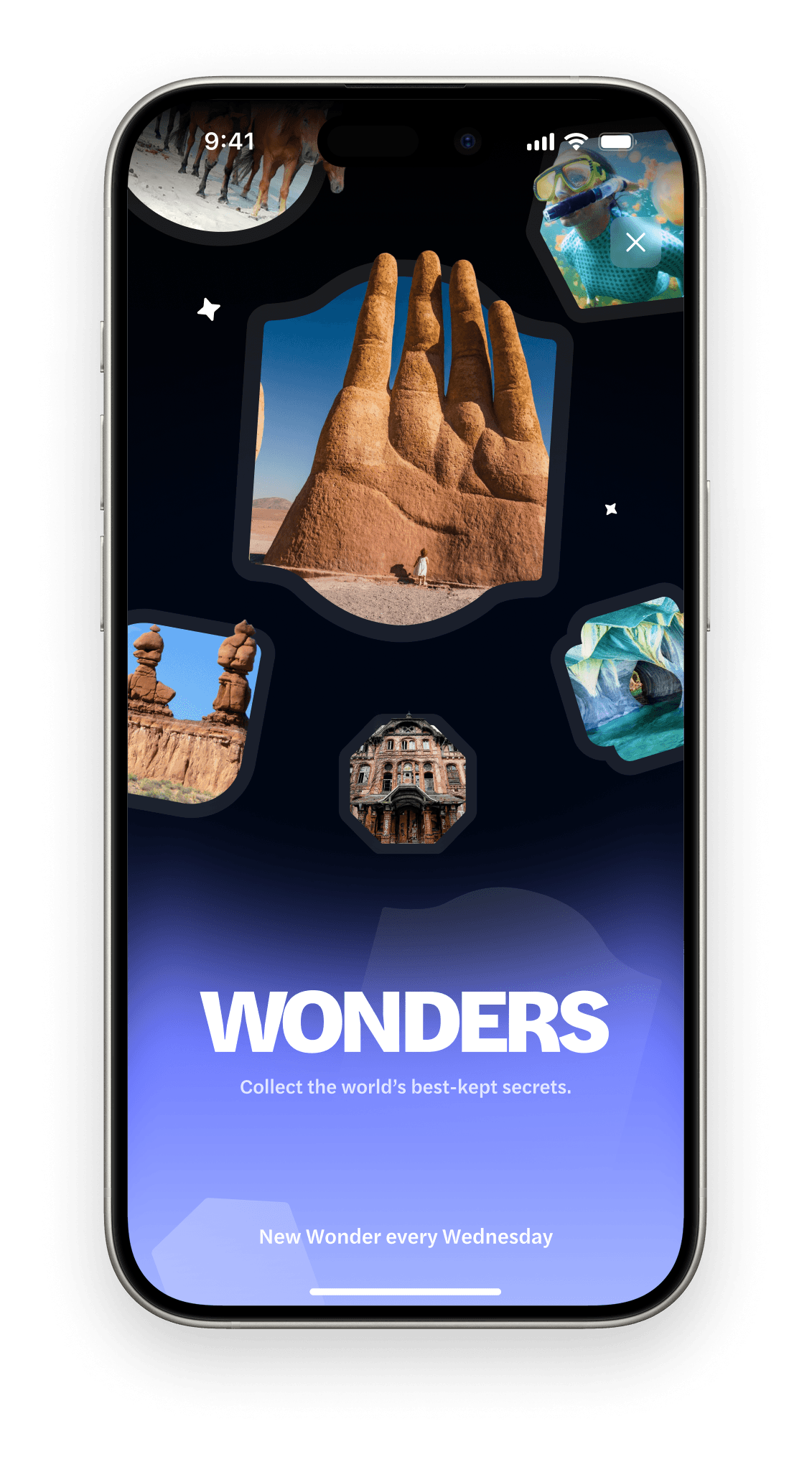
Wonders is a gamified weekly content drop built natively into the Headout app to turn a transactional utility into a weekly habit.
GOAL
Increase in the Checkout conversion so far
(goals not met)
5%
of 300k DAU engaging with Wonders by week 4
Increase in the Checkout conversion so far
(goals not met)
Team
1 Designer 👋
1 Designer 👋,
1 UX Engineer
1 Marketing Manager,
1 Product Manager
1 Product Manager,
1 UX Writer
1 UX Writer
5 weeks (2026)
5 weeks (2026)
Problem definition
Headout only exists when you need to book experiences
What possibly went wrong?
Headout is built for high-intent moments. Someone has a trip coming up, they know they want to do something, and they open the app to book it. Outside that window, the app has nothing to offer and users have no reason to return.
The current flow onboards a new user from the Headout booking website, the user books their experience there and is asked to download the app to access their ticket.


Context
Every user who forgets the app exists needs to be won back
Every user who forgot about Headout between trips needed to be re-acquired. That cost compounded. Users who stay familiar with the app book more. Users who forget it exists don't come back.
Context
Every user who forgets the app exists needs to be won back
Every user who forgot about Headout between trips needed to be re-acquired. That cost compounded. Users who stay familiar with the app book more. Users who forget it exists don't come back.
Solution direction
A starting point
The PM came with a base concept called Wednesday Wonders. Every Wednesday, one page about a remarkable place in the world. A collection screen to hold everything unlocked so far. That was the full extent of it. There was a rough prototype built on Replit to illustrate the idea.
My job was to take that starting point and figure out what it needed to actually become a habit.
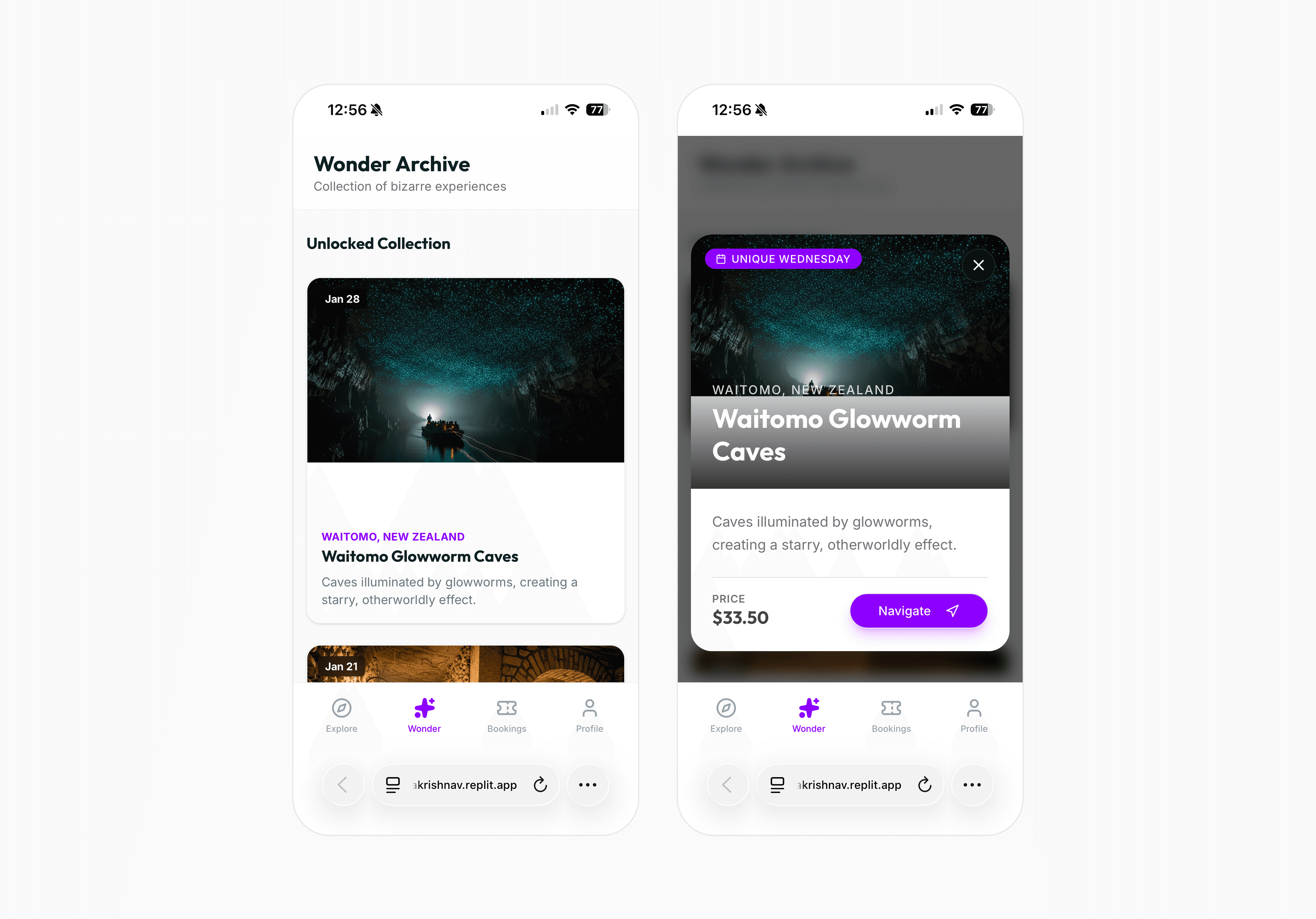
Replit prototype shared by the PM - acting as a starting point of the concept
Solution direction
A starting point
The PM came with a base concept called Wednesday Wonders. Every Wednesday, one page about a remarkable place in the world. A collection screen to hold everything unlocked so far. That was the full extent of it. There was a rough prototype built on Replit to illustrate the idea.
My job was to take that starting point and figure out what it needed to actually become a habit.
Replit prototype shared by the PM - acting as a starting point of the concept
Constraints
What Wonders was not allowed to be
An early proposal tried to attach a revenue bridge at the end of each Wonder story to justify the engineering cost. It was rejected immediately. A discovery experience that ends with a checkout prompt does not build trust, it just moves friction to a different screen.
There was also a friction point to understand whether this feature was to be built in react native, inside the app itself, or to be made as a web preview, although this was not a major constraint, and was something the stakeholders were flexible to work with.
Eventually, in-app react native build was finalized because the feature heavily relied on local storage, and the team decided that this would reduce complexities.
Thinking
The moment discovery becomes transactional, we have just built another funnel. Users clock that within two interactions and stop opening the feature entirely. The feature had to earn return visits on its own.

Constraints
What Wonders was not allowed to be
An early proposal tried to attach a revenue bridge at the end of each Wonder story to justify the engineering cost. It was rejected immediately. A discovery experience that ends with a checkout prompt does not build trust, it just moves friction to a different screen.
There was also a friction point to understand whether this feature was to be built in react native, inside the app itself, or to be made as a web preview, although this was not a major constraint, and was something the stakeholders were flexible to work with.
Eventually, in-app react native build was finalized because the feature heavily relied on local storage, and the team decided that this would reduce complexities.
Thinking
The moment discovery becomes transactional, we have just built another funnel. Users clock that within two interactions and stop opening the feature entirely. The feature had to earn return visits on its own.
Iterations
Visual concept directions
Initially 20 story concepts were iterated on, which I then shortlisted the 4 that works the best and iterated visual concepts for.
The iterations were something that evolved over time, but one thing was constant, the intent was to engage the users into a continuous story that they would feel the need to come back to and be curious to figure out what happens next. Not just about the places shown as Wonders, but also about their progress into this feature.
Thinking
The idea was to make the user feel that they were actually travelling to a new place every week, and show it through the perspective of a plane window, and once the journey is complete, the user would update that in their Travel journal, which would act as the collectible showing the success state

The traveller perspective to a new place every week
Users get the feel of a story experience
Was way too off from the Headout design style
Heavy dependency on the interactions
Hard to maintain the travel journal, needs personalization every week
Iterations
Visual concept directions
Initially 20 story concepts were iterated on, which I then shortlisted the 4 that works the best and iterated visual concepts for.
The iterations were something that evolved over time, but one thing was constant, the intent was to engage the users into a continuous story that they would feel the need to come back to and be curious to figure out what happens next. Not just about the places shown as Wonders, but also about their progress into this feature.
Thinking
The idea was to make the user feel that they were actually travelling to a new place every week, and show it through the perspective of a plane window, and once the journey is complete, the user would update that in their Travel journal, which would act as the collectible showing the success state
Users get the feel of a story experience
Was way too off from the Headout design style
Heavy dependency on the interactions
Hard to maintain the travel journal, needs personalization every week
Thinking
The concept was of photographs, something that almost everyone takes as a memory of the trip they visit. The user when given a choice makes an intentional choice, making the users feel attached to the choice they made, so the Wonder would feel more personal to them. Finally the collection would be a camera reel continuing the theme.
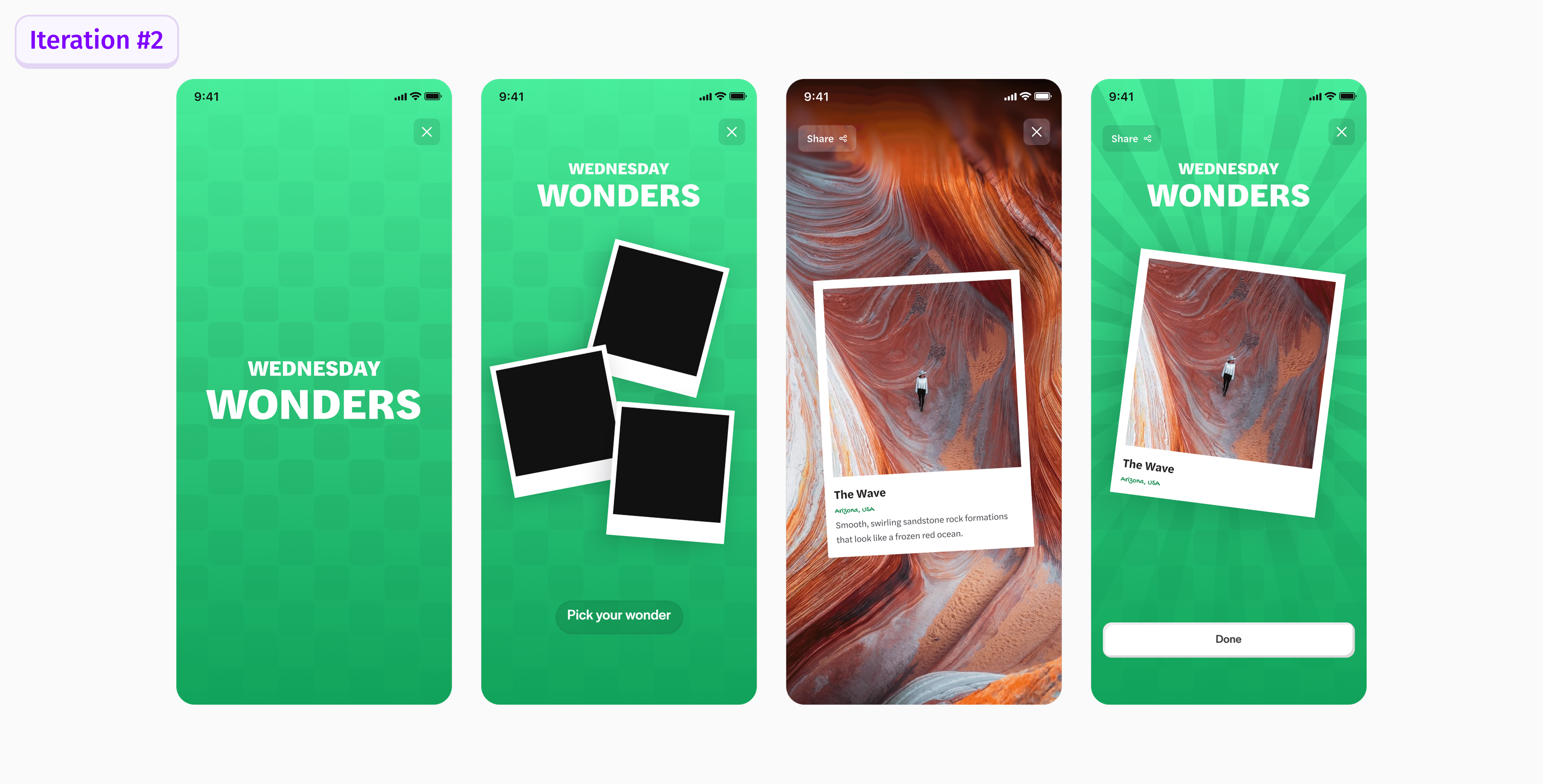
User gets to pick the destination they would want to go to
Makes the Wonder feel more personal to the user
Harder to maintain 3 options on the CMS, not worth the dev. effort for V1
Requires 3 curated content and image set for each week instead of 1 now
Thinking
The concept was of photographs, something that almost everyone takes as a memory of the trip they visit. The user when given a choice makes an intentional choice, making the users feel attached to the choice they made, so the Wonder would feel more personal to them. Finally the collection would be a camera reel continuing the theme.
Makes the Wonder feel more personal to the user
Harder to maintain 3 options on the CMS, not worth the dev. effort for V1
Requires 3 curated content and image set for each week instead of 1 now
Thinking
Continuing with the previous iteration, the camera reel was made to feel more emotional, replacing a regular camera shot with a Polaroid, targeting the primary audience for the app, young adults. The loading state was intentionally designed in such a way that it would show the users that there are multiple Wonders yet to come, and this was just one of them, reminding the users to stay hooked on.
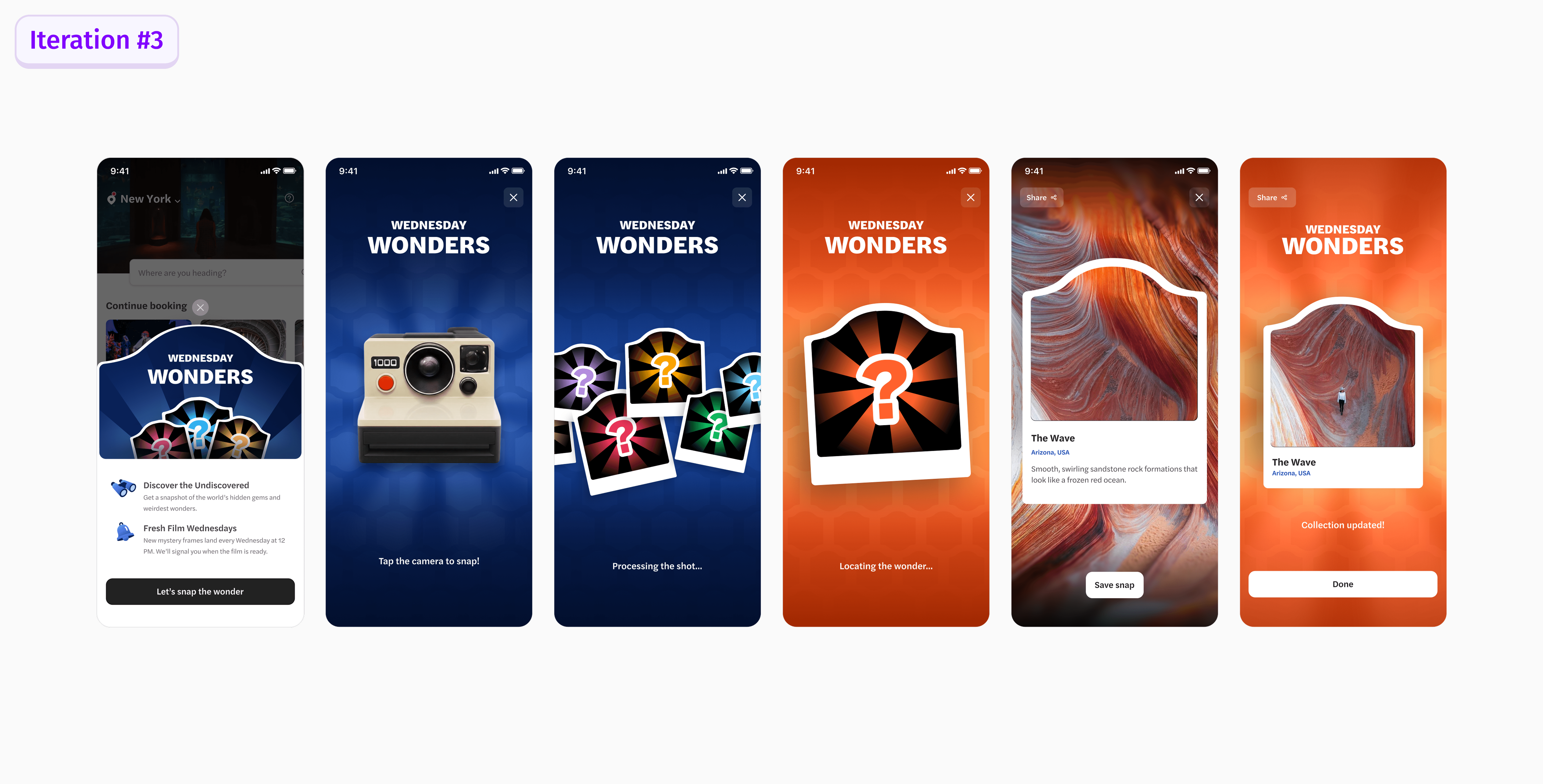
The Polaroid design theme, connecting the users emotional nostalgia
Connects with the users' nostaligia
Simplified template, no CMS complications
Slightly off the Headout design style
The polaroid content structure isn't expandable for multiple content slides
Thinking
Continuing with the previous iteration, the camera reel was made to feel more emotional, replacing a regular camera shot with a Polaroid, targeting the primary audience for the app, young adults. The loading state was intentionally designed in such a way that it would show the users that there are multiple Wonders yet to come, and this was just one of them, reminding the users to stay hooked on.
Connects with the users' nostaligia
Simplified template, no CMS complications
Slightly off the Headout design style
The polaroid content structure isn't expandable for multiple content slides
Thinking
The idea was to introduce a locked portal, where each portal unlocks a new Wonder. A key to the next portal lands on each Wednesday and then stays available for the whole week. The loading animation would ensure that the lock would pick a random portal and then unlock it, still showing the pending other portals/Wonders left to be unlocked. Finally, a streak would be maintained for each week.
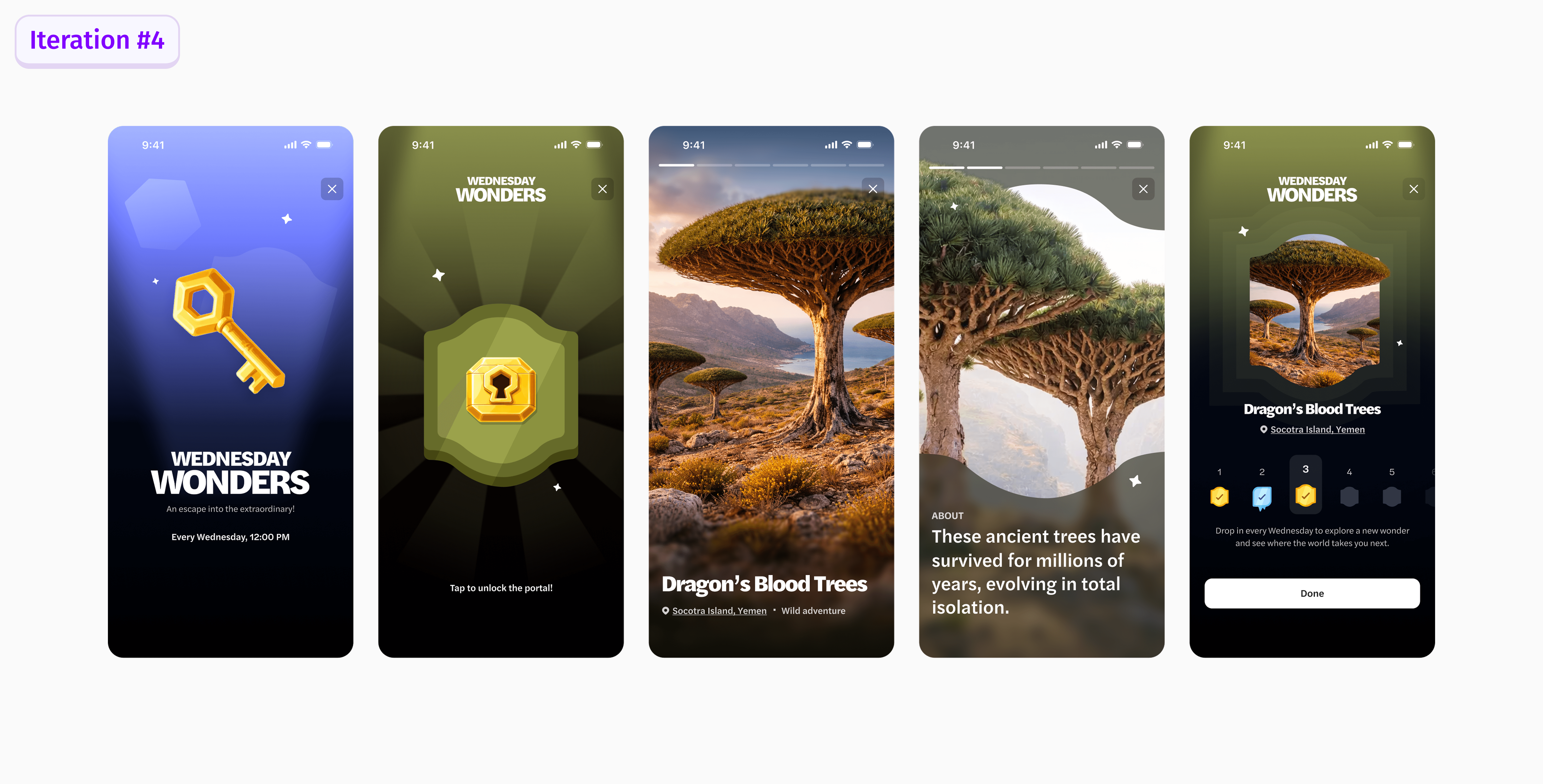
Unlocking the portal concept with a key dropping every Wednesday
Simplifies the template to add more content slides
Hard to maintain colors for each section and each Wonder every week on the CMS
The images coming out of the portal although matches Headout design system, would be hard to maintain on the CMS. Each image would need manual editing
Thinking
The idea was to introduce a locked portal, where each portal unlocks a new Wonder. A key to the next portal lands on each Wednesday and then stays available for the whole week. The loading animation would ensure that the lock would pick a random portal and then unlock it, still showing the pending other portals/Wonders left to be unlocked. Finally, a streak would be maintained for each week.
Simplifies the template to add more content slides
Hard to maintain colors for each section and each Wonder every week on the CMS
The images coming out of the portal although matches Headout design system, would be hard to maintain on the CMS. Each image would need manual editing
Thinking
The concept of portals was locked because that aligned the most with Headout's design system. The portals were not classified into 6 categories, 10 portals each. The users could complete the collection of 10 for each at the end of the feature. Multiple levels of gratification was also introduced because it was a weekly feature and the risk of drop-off was high.
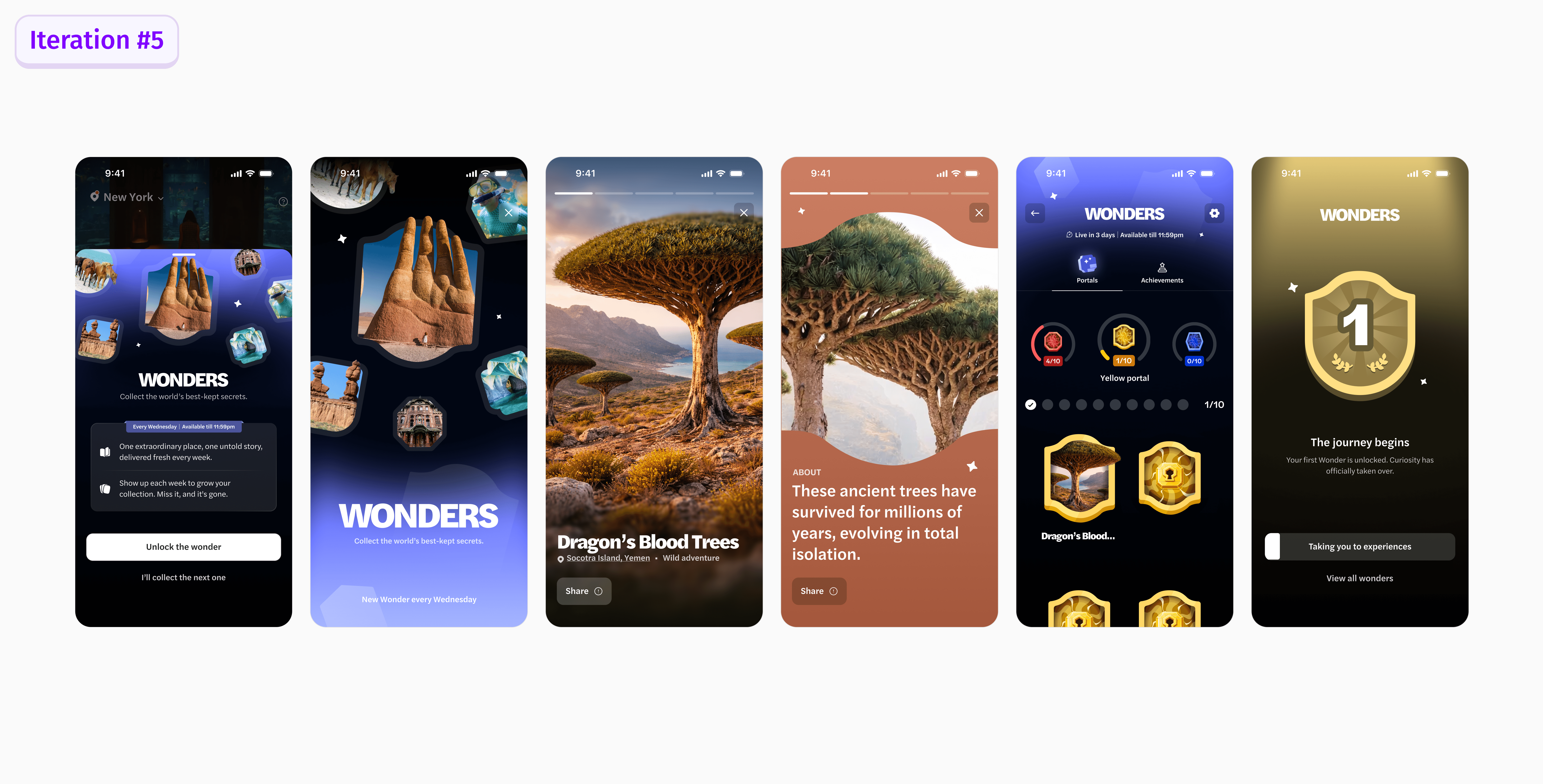
Final Wonders design - Portal unlocks every week from a random category
Simplifies CMS integration without a weekly effort other than for images and content
Introduces gratification to motivate users to stay hooked on
Not yet curated/personalized for each user for V1 experimentation
Thinking
The concept of portals was locked because that aligned the most with Headout's design system. The portals were not classified into 6 categories, 10 portals each. The users could complete the collection of 10 for each at the end of the feature. Multiple levels of gratification was also introduced because it was a weekly feature and the risk of drop-off was high.
Simplifies CMS integration without a weekly effort other than for images and content
Introduces gratification to motivate users to stay hooked on
Not yet curated/personalized for each user for V1 experimentation
Implementation
Dividing the Wonders into 6 categories
Working closely with the UX writer, I divided the selected 60 wonders into 6 categories, each resonating with a portal.
They were divided into 6 categories mainly because it would fit well with the narrative of the feature being launched for a year, at least, and also stays consistent with the 6 portals that Headout uses in the branding.
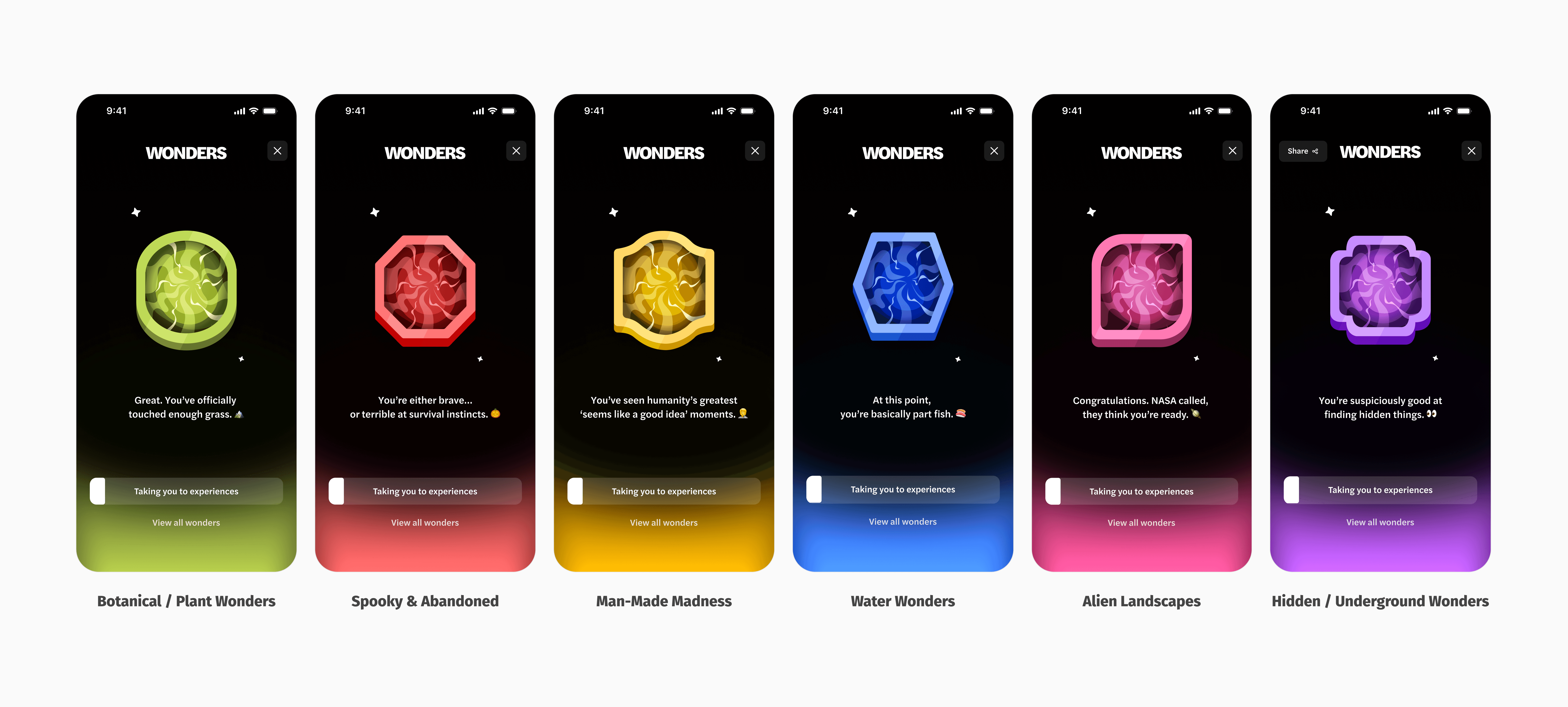
6 categories success state after completion of the portal collections
Implementation
Dividing the Wonders into 6 categories
Working closely with the UX writer, I divided the selected 60 wonders into 6 categories, each resonating with a portal.
They were divided into 6 categories mainly because it would fit well with the narrative of the feature being launched for a year, at least, and also stays consistent with the 6 portals that Headout uses in the branding.
6 categories success state after completion of the portal collections
Standardizing the story view
To ensure that the main content was easy to maintain with very minimal effort for each week, I ensured that we could make this into a template the way it would be maintained on code.
By logging the category, the system would automatically pick the portal for clipping the image. The maintainers only need to add the content, the image and choose the position of the content, based on the 4 templates.

The primary location reveal banner and the 4 templates for switching between the clipping and content position
Standardizing the story view
To ensure that the main content was easy to maintain with very minimal effort for each week, I ensured that we could make this into a template the way it would be maintained on code.
By logging the category, the system would automatically pick the portal for clipping the image. The maintainers only need to add the content, the image and choose the position of the content, based on the 4 templates.
The primary location reveal banner and the 4 templates for switching between the clipping and content position
Updating the collection
Once the user completes the whole content view, the success state fires, which basically confirms the user that this Wonder is updated to their collection, and gives a visual check on their progress so far in that portal collection.
This is stored in a dedicated tab for Wonders, which the user can access anytime, and is not limited to a Wednesday.
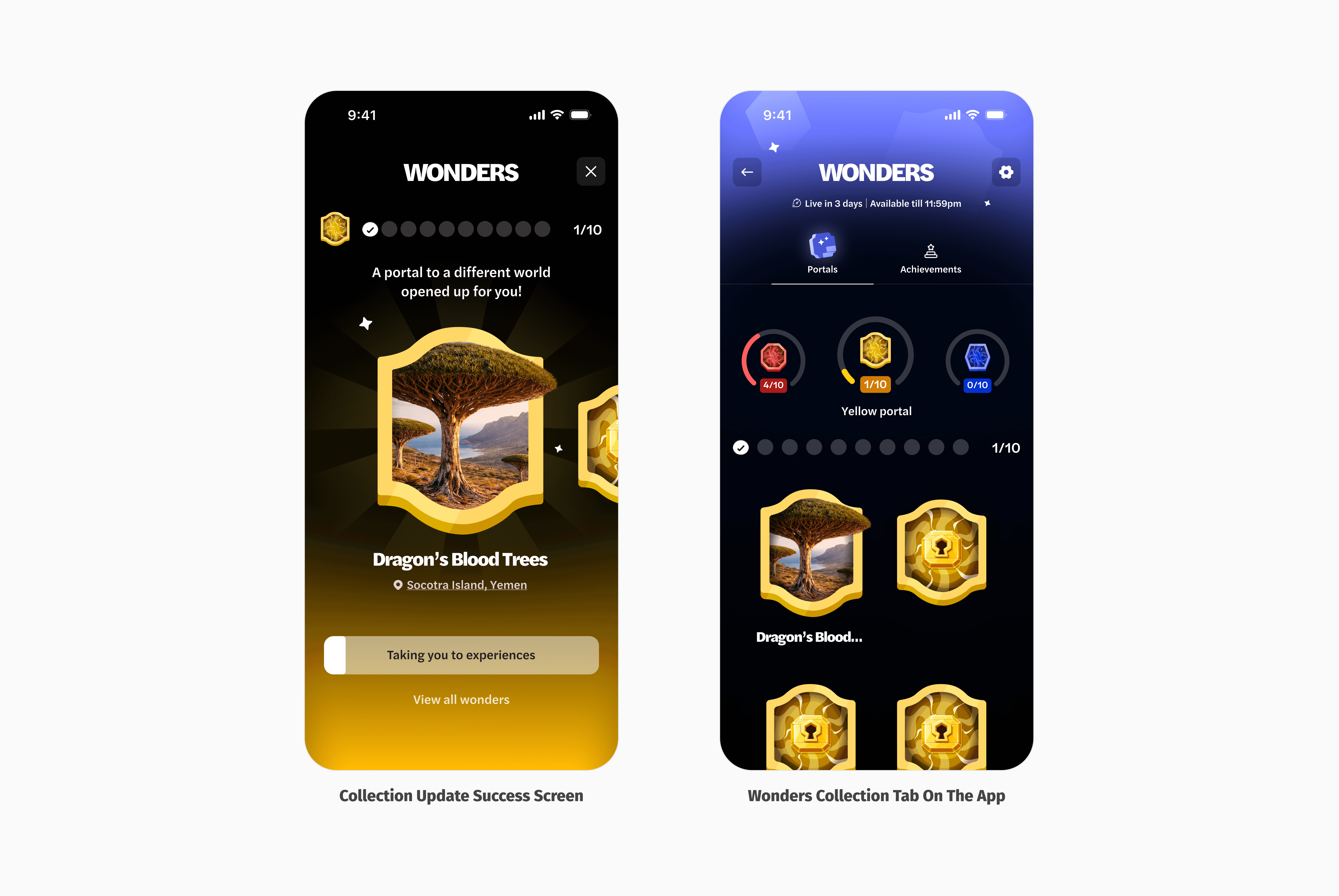
The collection successfully updated state and the collection tab screen
Updating the collection
Once the user completes the whole content view, the success state fires, which basically confirms the user that this Wonder is updated to their collection, and gives a visual check on their progress so far in that portal collection.
This is stored in a dedicated tab for Wonders, which the user can access anytime, and is not limited to a Wednesday.
The collection successfully updated state and the collection tab screen
Portals weekly drop mechanism
Along with the visual iterations, I explored a couple of logical approaches to figure out what mechanism for the weekly drops of Wonders work the best.
I iterated 3 major approaches for this, and selected the one that made the most sense.
Thinking
The idea was to treat these portals as leagues, and after completion of each portal, the user would be promoted to the next. But the main flaw in the logic here was the categorization of Wonders into these 6 portals.
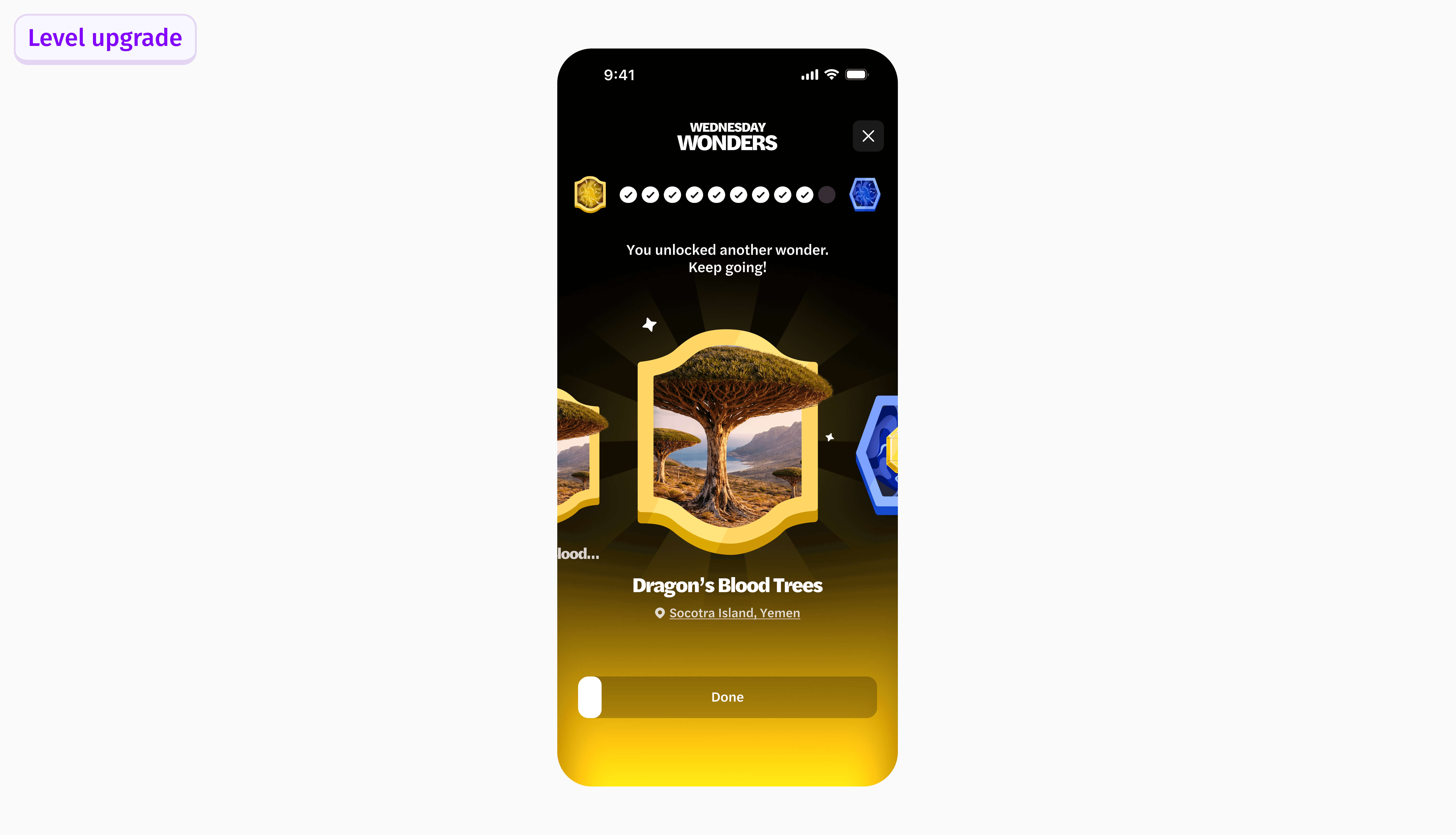
Level upgrade - each Portal completion unlocks the next portal to continue the collection of 10
Gives a clear visible goal to the user
The user has full context on the timeline
If a user is not interested in the category, then they drop-off
Portals weekly drop mechanism
Along with the visual iterations, I explored a couple of logical approaches to figure out what mechanism for the weekly drops of Wonders work the best.
I iterated 3 major approaches for this, and selected the one that made the most sense.
Thinking
The idea was to treat these portals as leagues, and after completion of each portal, the user would be promoted to the next. But the main flaw in the logic here was the categorization of Wonders into these 6 portals.
Gives a clear visible goal to the user
The user has full context on the timeline
If a user is not interested in the category, then they drop-off
Thinking
The concept was that the user would get a regular gratification, everytiime they complete a Wonder, they would maintain the streak. But the concept of Wonders was such that the users would not be able to access these Wonders once they miss it. Comparing with other similar streaks like Duolingo or Linkedin, their structure is a daily streak, against a weekly streak, which is a longer gap, and needs freeze streak, which is not possible in this case.
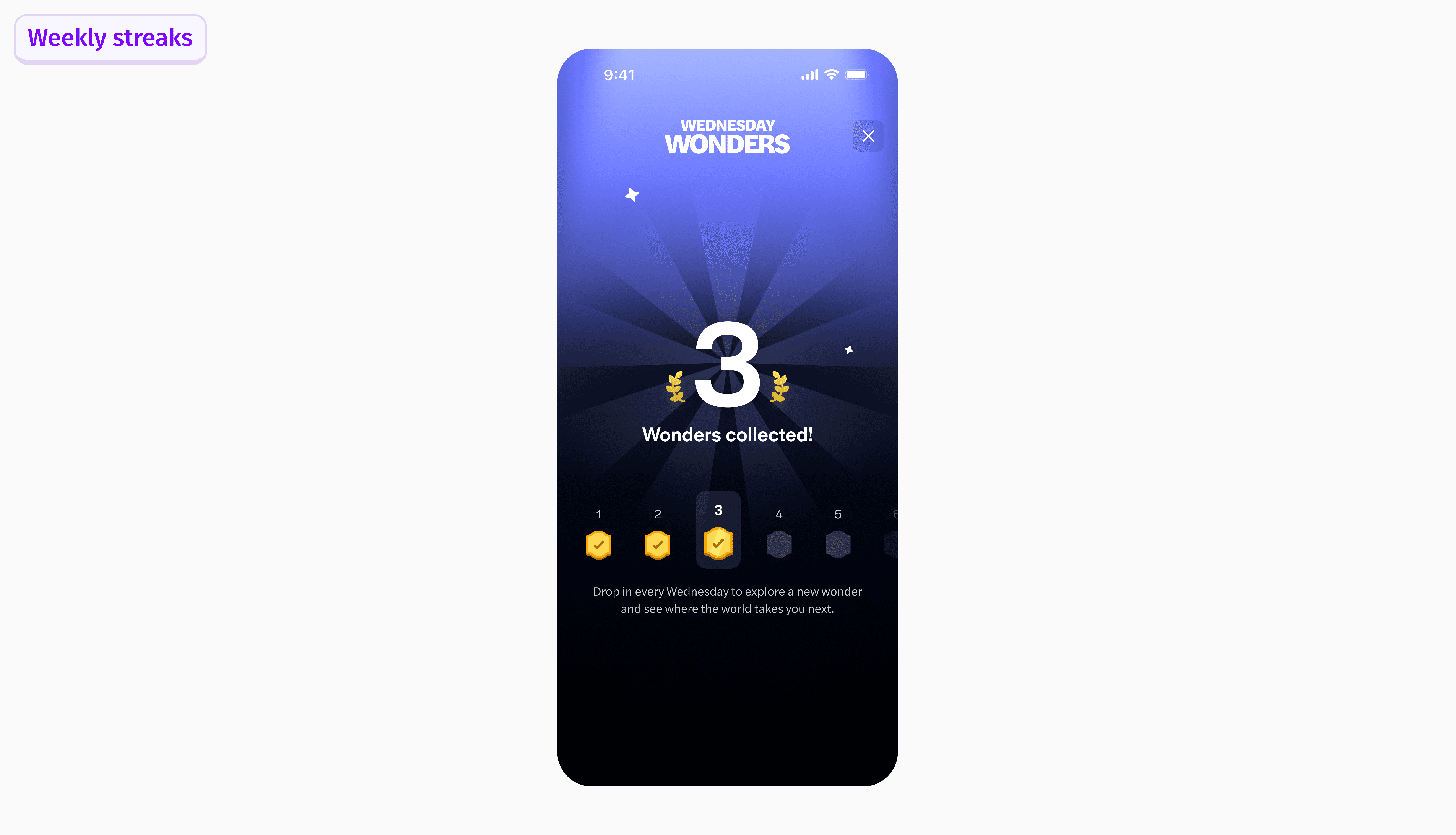
Weekly streak - maintain a tab on consistency of the user
Randomizes the Wonders so no category bias
Adding streaks as a gratification removes the more important collection aspect
If the user misses a streak, there is no streak freeze, hence would lead to drop-off
Thinking
The concept was that the user would get a regular gratification, everytiime they complete a Wonder, they would maintain the streak. But the concept of Wonders was such that the users would not be able to access these Wonders once they miss it. Comparing with other similar streaks like Duolingo or Linkedin, their structure is a daily streak, against a weekly streak, which is a longer gap, and needs freeze streak, which is not possible in this case.
Randomizes the Wonders so no category bias
Adding streaks as a gratification removes the more important collection aspect
If the user misses a streak, there is no streak freeze, hence would lead to drop-off
Thinking
This would randomize the drops for each week, and not constrain the user with a particular category. The user now collects a random Wonder from a random portal each week, and it adds into the collection. Eventually, when any collection is done, the user gets gratified, and is also motivated to come back because of the curiousity of which portal might drop this week.
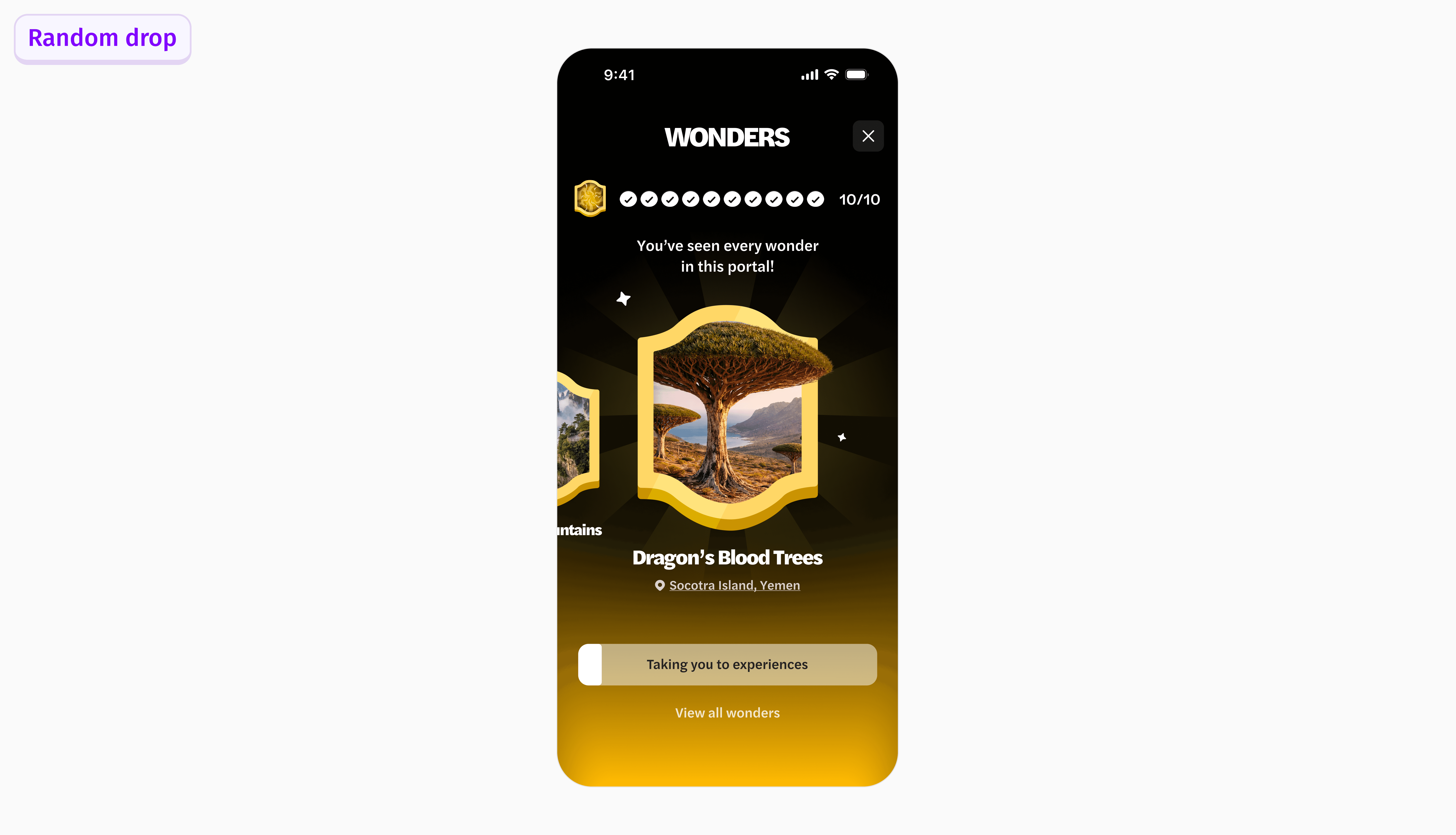
Random drop - every week, a random Wonder from a random Portal collection drops. This eventually adds on to form the collection
Randomizes the drops, so no category bias
The user has a clear goal visible
Increases the gap for achieving a collection
Thinking
This would randomize the drops for each week, and not constrain the user with a particular category. The user now collects a random Wonder from a random portal each week, and it adds into the collection. Eventually, when any collection is done, the user gets gratified, and is also motivated to come back because of the curiousity of which portal might drop this week.
Randomizes the drops, so no category bias
The user has a clear goal visible
Increases the gap for achieving a collection
Random drop was the best solution
Random drop was the best solution
Even though random drops had a significant demerit, which could increase drop-offs, the merits outweighed the demerit. And the demerit was compensated for.
Even though random drops had a significant demerit, which could increase drop-offs, the merits outweighed the demerit. And the demerit was compensated for.
The need for multiple gratification
After a review discussion with the entire design team, it was identified that the drop mechanism is placed in such a way that the users will reach the first gratification of completing the 10 portals in a set after at least 30 weeks, based on the drop schedule, which would mostly be based on probability of occurrence.
Thinking
This was the most base level gratification. A collection completion gratification, which shows up after a user collects all 10 Wonders of a particular portal. The main issue with this was that these gratifications would be a very rare occurance and would require the user to be consistent for a very long time.
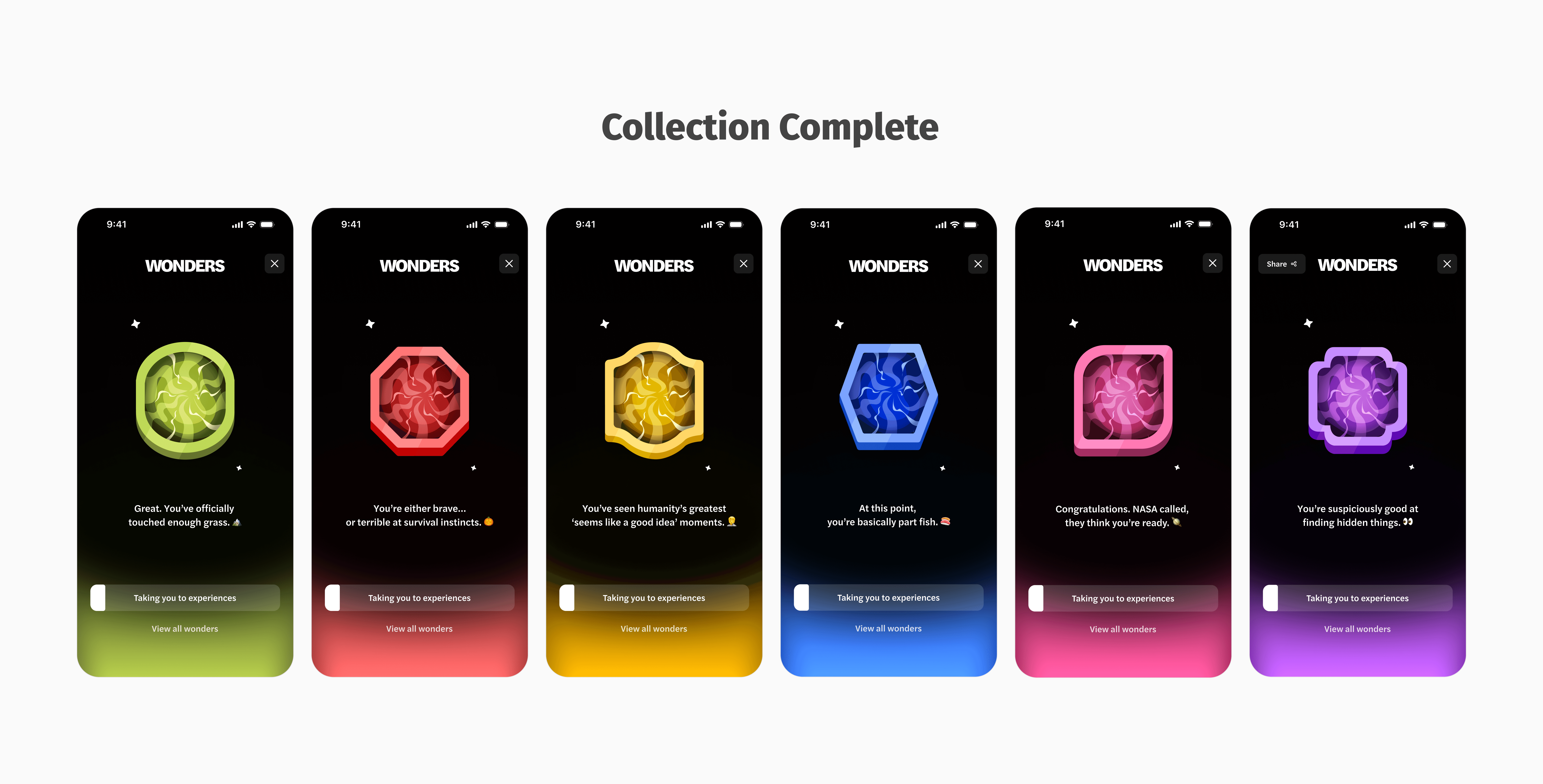
Collection complete state - appears when the user has successfully collected all 10 Wonders of a Portal
The need for multiple gratification
After a review discussion with the entire design team, it was identified that the drop mechanism is placed in such a way that the users will reach the first gratification of completing the 10 portals in a set after at least 30 weeks, based on the drop schedule, which would mostly be based on probability of occurrence.
Thinking
This was the most base level gratification. A collection completion gratification, which shows up after a user collects all 10 Wonders of a particular portal. The main issue with this was that these gratifications would be a very rare occurance and would require the user to be consistent for a very long time.
Collection complete state - appears when the user has successfully collected all 10 Wonders of a Portal
Thinking
A more frequent form of gratification, which applauses the user for completing a certain milestone number of Wonders. The milestones were organized in such a way that initially, it would start with the 1st Wonder, to introduce the concept of these milestones. These badges are more frequent initially, and reduces the frequency over time, as the users would be more commited and would have formed a habit.
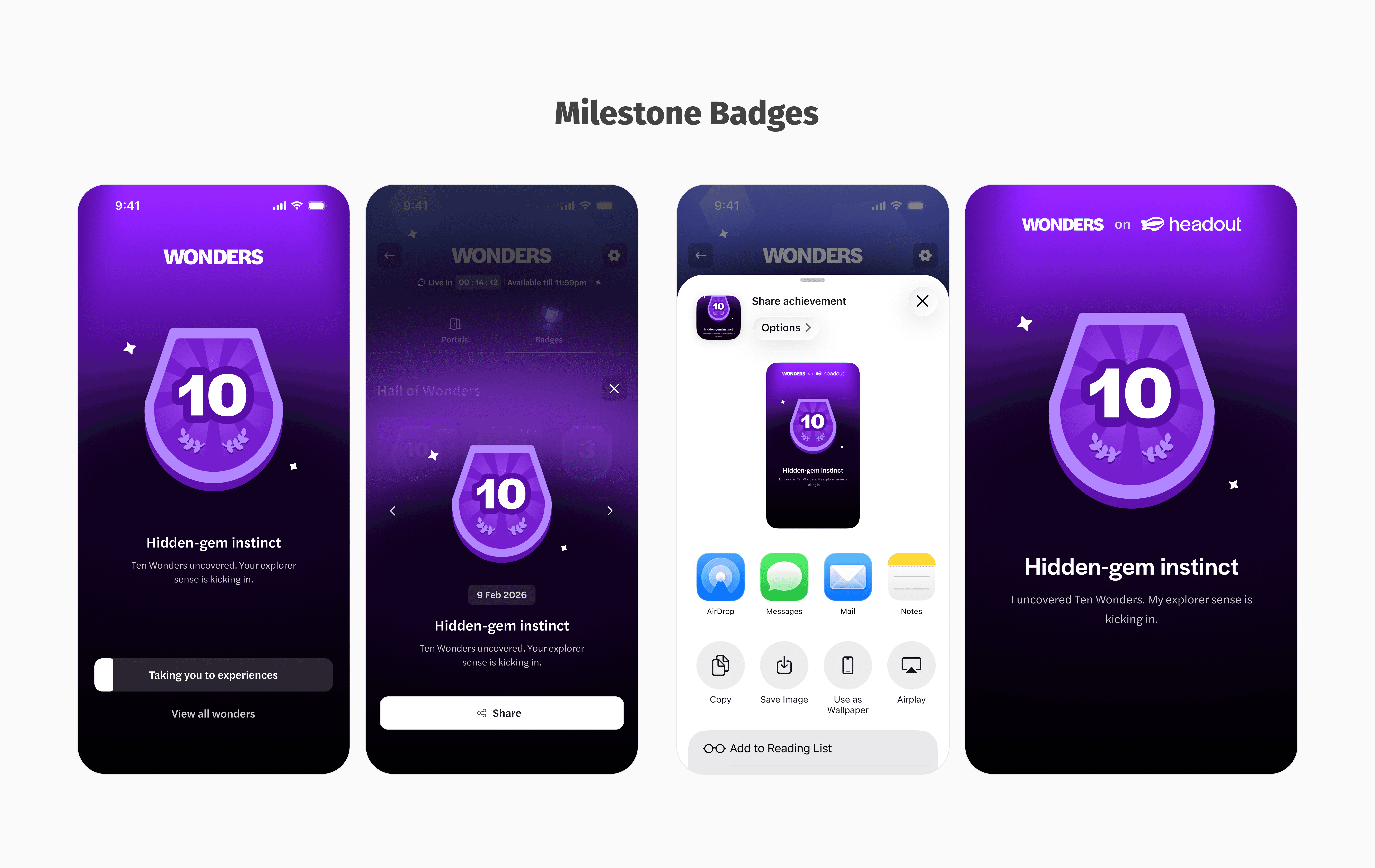
Milestone badge - The user gets to collect these badges once they collect a certain number of Wonders
Thinking
A more frequent form of gratification, which applauses the user for completing a certain milestone number of Wonders. The milestones were organized in such a way that initially, it would start with the 1st Wonder, to introduce the concept of these milestones. These badges are more frequent initially, and reduces the frequency over time, as the users would be more commited and would have formed a habit.
Milestone badge - The user gets to collect these badges once they collect a certain number of Wonders
Thinking
These were added as a seperate set of collection that goes on parallely with the Wonders the users would have collected. The primary purpose of this was to ensure that the users could reference to their Wonders collection later on, when they plan their travel, and think about visiting this cool place that they learnt about on Wonders. Headout is a travel booking platform, even though we didn't want to directly monetize the feature, I tried to indirectly introduce a connection that could potentially link to a purchase intent.
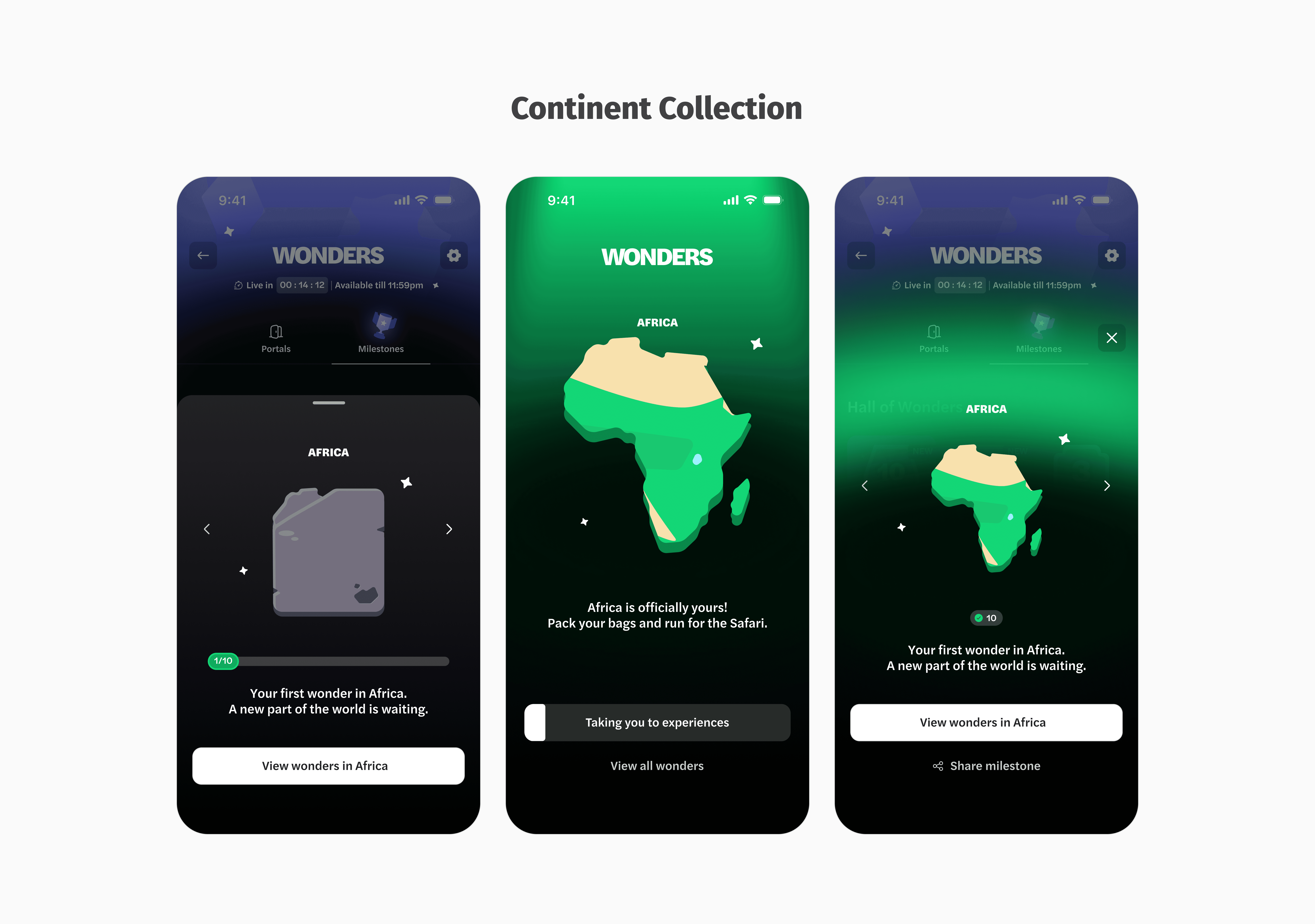
Continent collection - A parallely run collection mainly for future reference for trip planning for the user
Thinking
These were added as a seperate set of collection that goes on parallely with the Wonders the users would have collected. The primary purpose of this was to ensure that the users could reference to their Wonders collection later on, when they plan their travel, and think about visiting this cool place that they learnt about on Wonders. Headout is a travel booking platform, even though we didn't want to directly monetize the feature, I tried to indirectly introduce a connection that could potentially link to a purchase intent.
Continent collection - A parallely run collection mainly for future reference for trip planning for the user
Formulating all the entry touchpoints
Based on the flexibility I had to advertise the feature, I figured we could start with the website, and for app users, we could introduce a drawer and push-notifications.
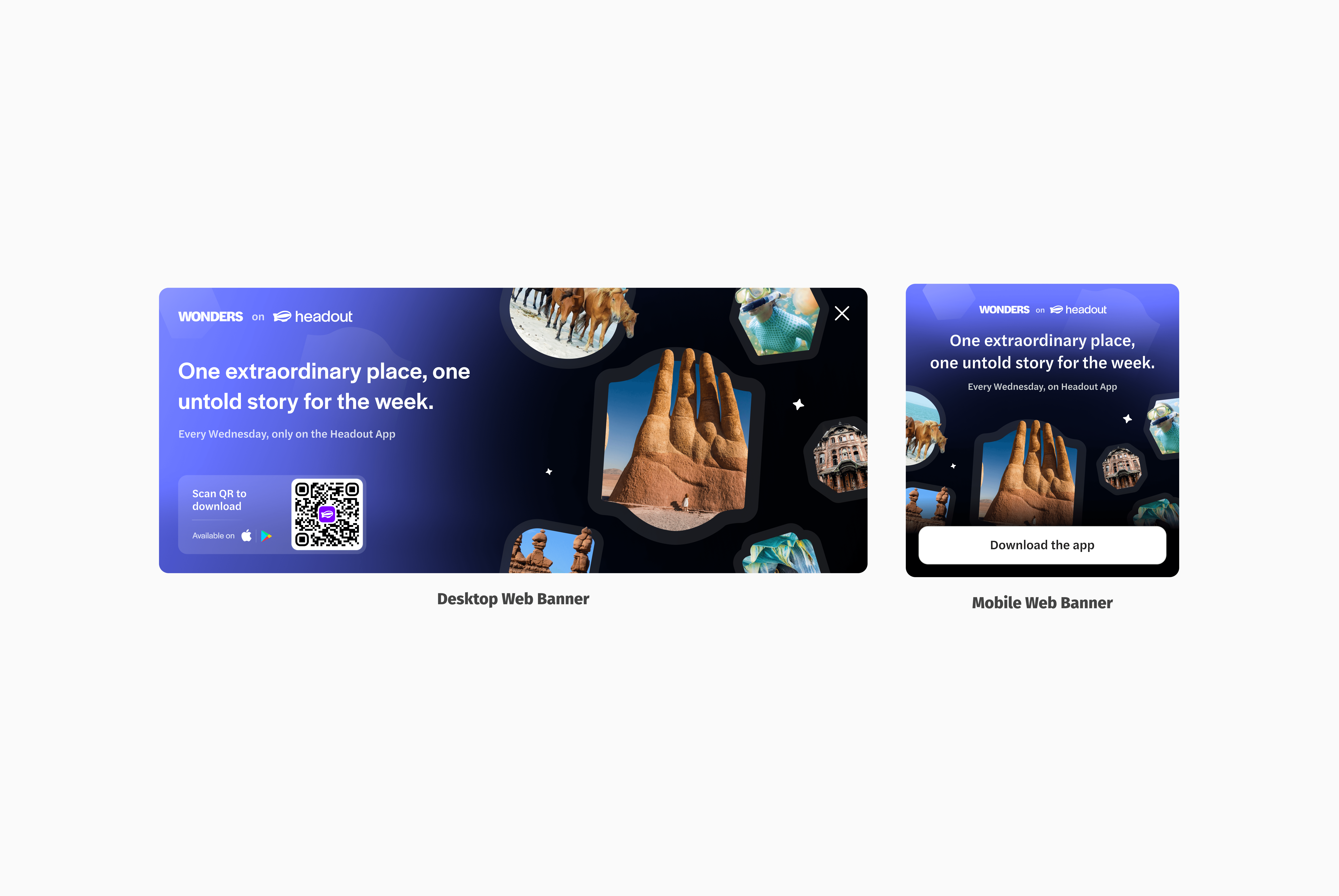
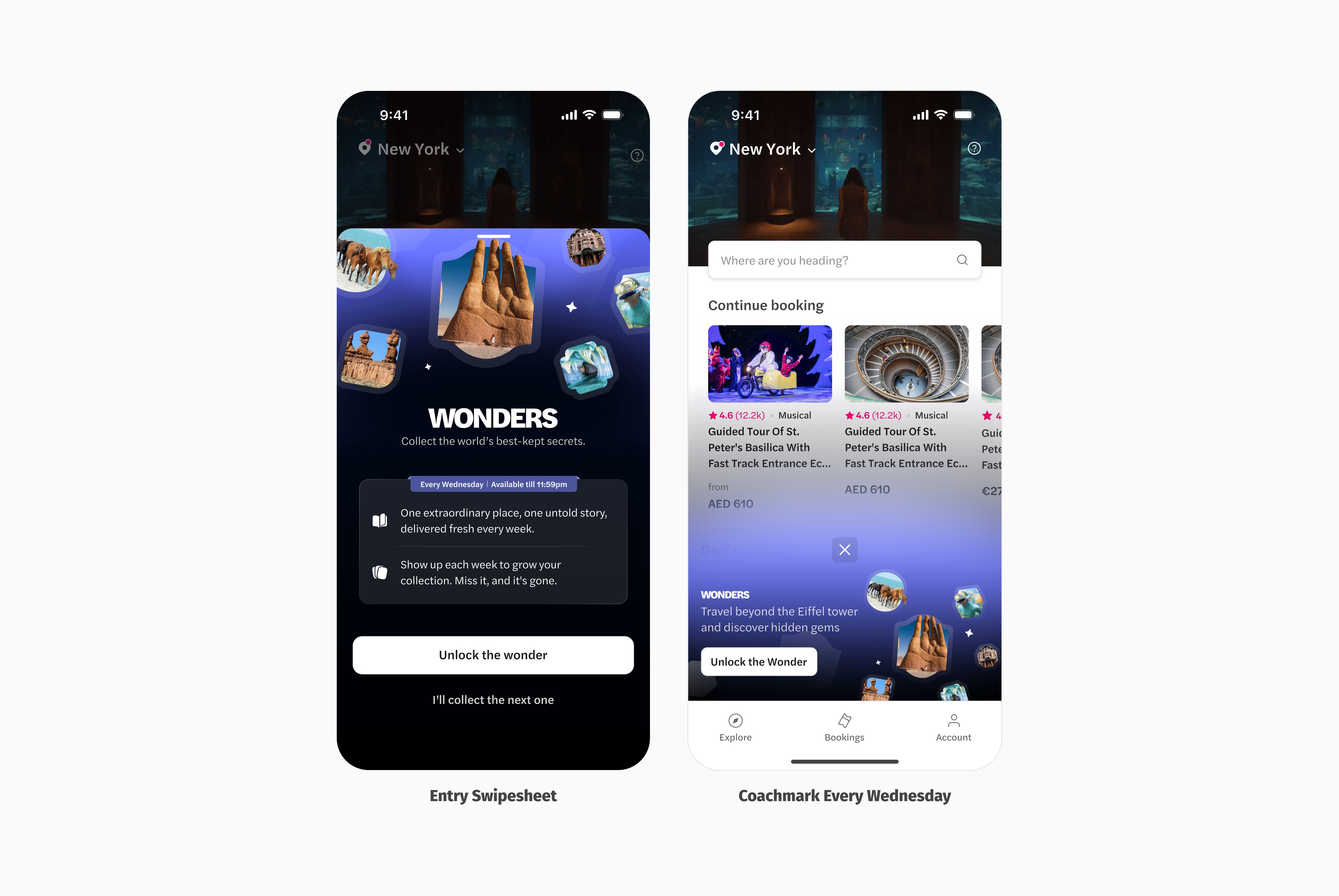

Entry touchpoints for Wonders - banner, drawer and push notification
Formulating all the entry touchpoints
Based on the flexibility I had to advertise the feature, I figured we could start with the website, and for app users, we could introduce a drawer and push-notifications.
Entry touchpoints for Wonders - banner, drawer and push notification
Finding the feature a home
Three placements were evaluated before landing on a decision.
Thinking
The Discovery tab gives Wonders premium placement without creating a dead zone. The feature does not need to be visible every day. It needs to be findable on Wednesday.
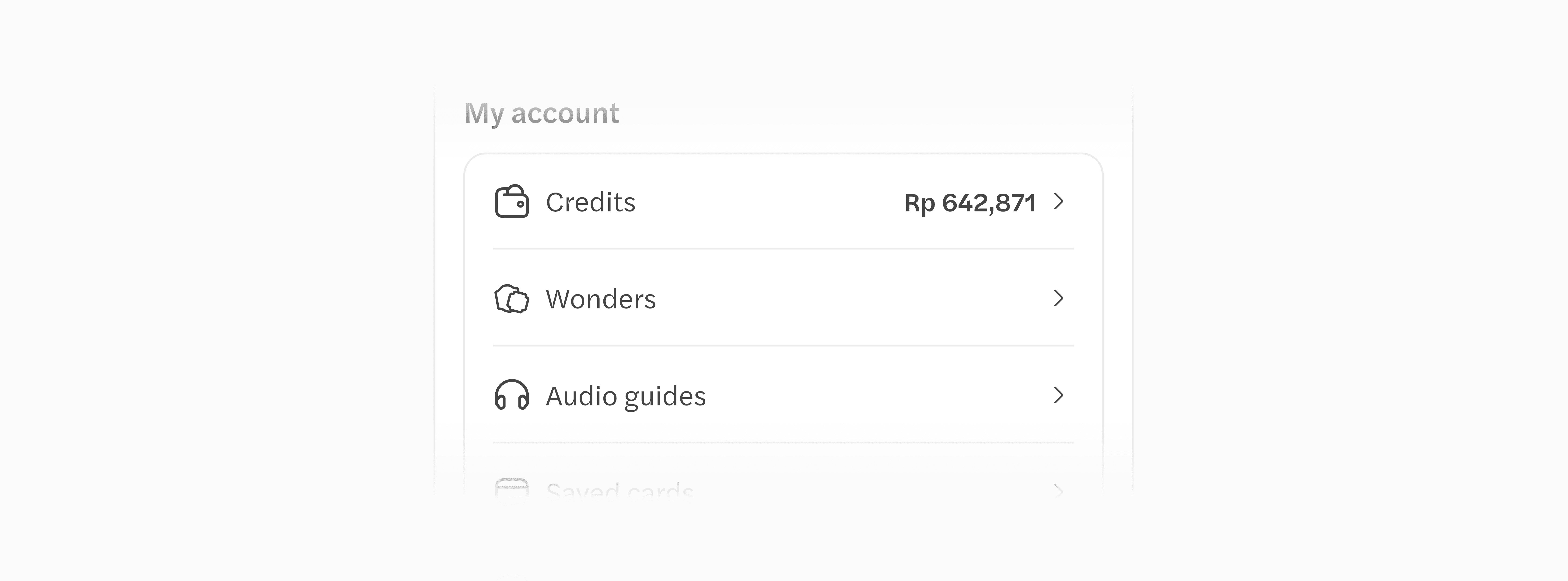
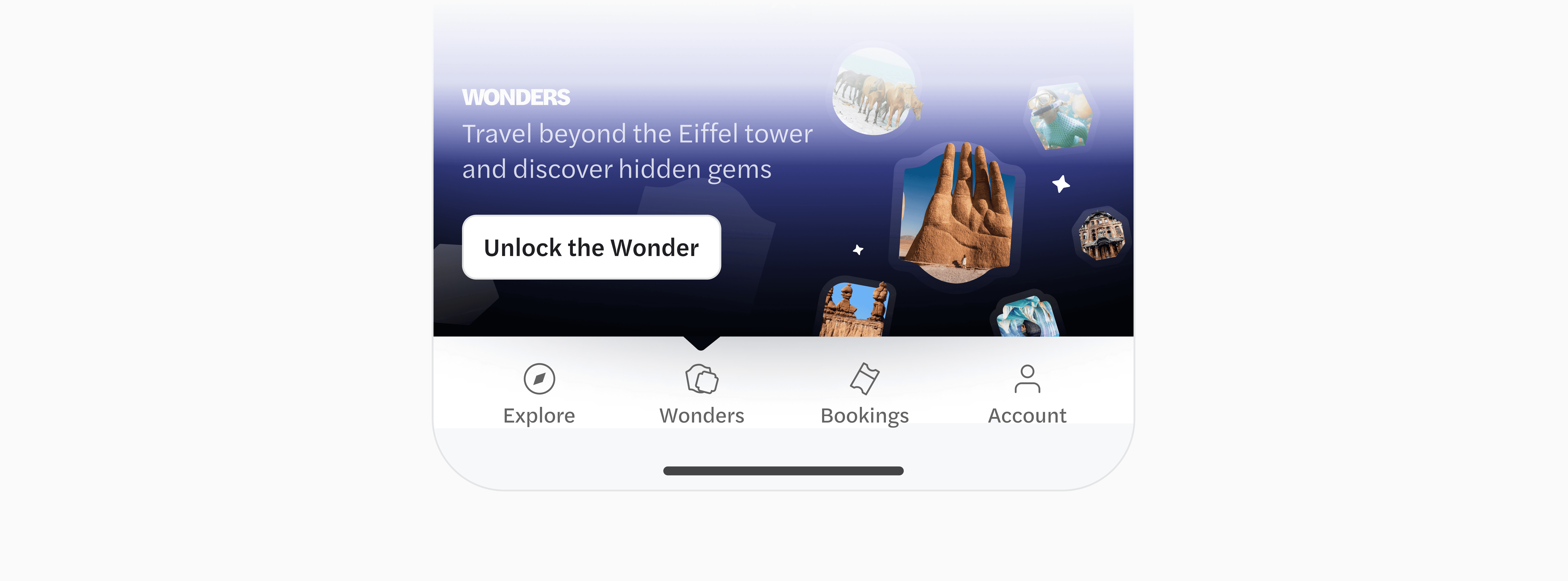
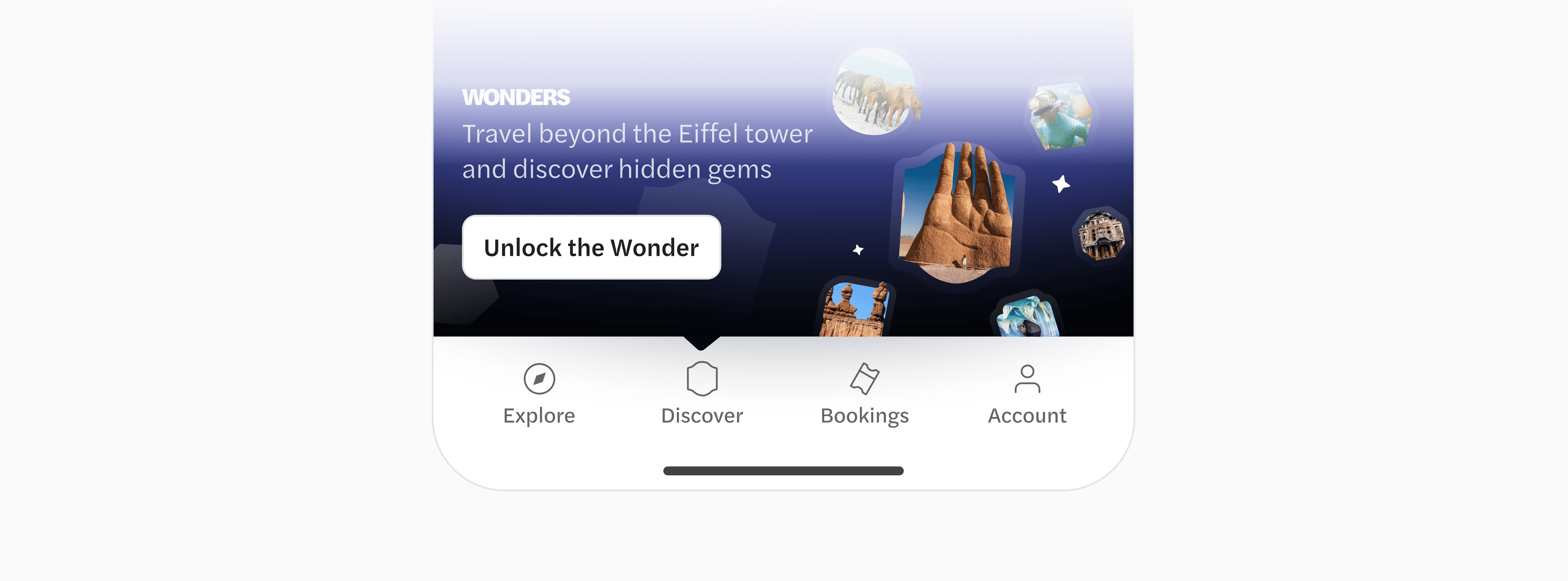
Feature placement on the app - Profile tab, dedicated 4th tab or Shared discovery tab
Profile tab
Hides the feature behind a utility menu
A retention loop that requires users to seek it out has near-zero DAU
Dedicated fourth tab
Guaranteed visibility, but a tab active one day a week is a dead zone the other six
Dedicating 25% of the app's prime real estate to a weekly feature does not hold
Shared Discovery tab
Wonders is one of multiple features in a broader Discovery tab without owning one entirely
Finding the feature a home
Three placements were evaluated before landing on a decision.
Thinking
The Discovery tab gives Wonders premium placement without creating a dead zone. The feature does not need to be visible every day. It needs to be findable on Wednesday.
Feature placement on the app - Profile tab, dedicated 4th tab or Shared discovery tab
Profile tab
Hides the feature behind a utility menu
A retention loop that requires users to seek it out has near-zero DAU
Dedicated fourth tab
Guaranteed visibility, but a tab active one day a week is a dead zone the other six
Dedicating 25% of the app's prime real estate to a weekly feature does not hold
Shared Discovery tab
Wonders is one of multiple features in a broader Discovery tab without owning one entirely
Shared discovery tabs won
Shared discovery tabs won
This was an easy choice, mainly because, there were multiple other similar features that Headout was introducing, like Headout games, and Headout City of the Month. This basically paved the way for this shared discovery tab.
This was an easy choice, mainly because, there were multiple other similar features that Headout was introducing, like Headout games, and Headout City of the Month. This basically paved the way for this shared discovery tab.
Edge case
What if I start using the feature 20 week into the launch?
I hit a hard wall on a natural edge case, what if the user starts using the feature 20 weeks into the launch? Does it mean, they lost 19 Wonders already? Easy drop-off.
Technically yes, based on the way the feature is placed. But I arranged this in a way that the 20th Wonder would now be the user's first Wonder. This way, the user will continue on with their Wonder-ful journey, without any doubts.
Thinking
I was trying to ensure that the user doesn't feel like they have lost the 19 Wonders already. But what happens to these 19 Wonders? If the feature is successful, and continues, then there's no need for those 19. For those users who have already completed the collection, the collection just resets. Basically, a level 2 of the same Portals.
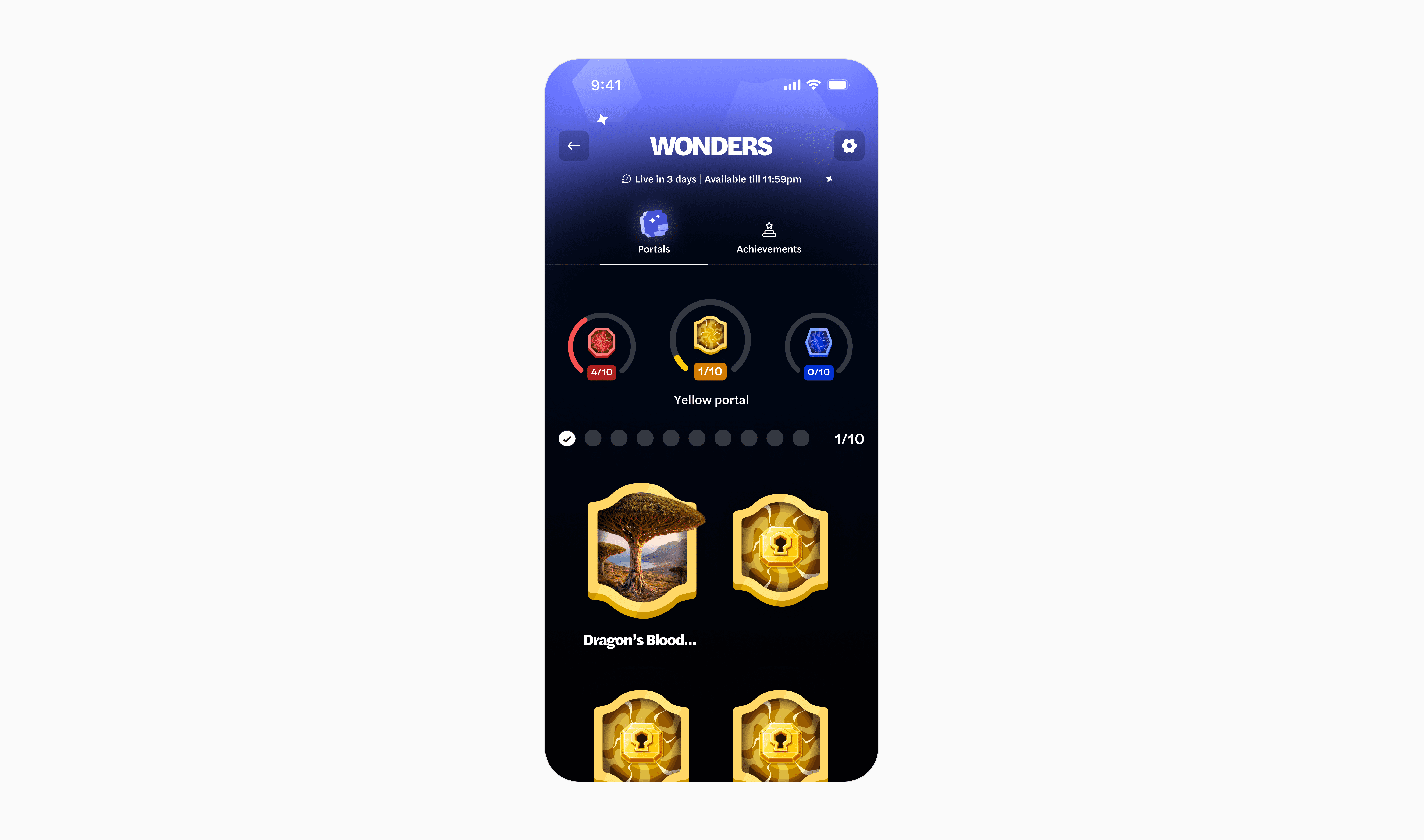
Wonders collection page
Edge case
What if I start using the feature 20 week into the launch?
I hit a hard wall on a natural edge case, what if the user starts using the feature 20 weeks into the launch? Does it mean, they lost 19 Wonders already? Easy drop-off.
Technically yes, based on the way the feature is placed. But I arranged this in a way that the 20th Wonder would now be the user's first Wonder. This way, the user will continue on with their Wonder-ful journey, without any doubts.
Thinking
I was trying to ensure that the user doesn't feel like they have lost the 19 Wonders already. But what happens to these 19 Wonders? If the feature is successful, and continues, then there's no need for those 19. For those users who have already completed the collection, the collection just resets. Basically, a level 2 of the same Portals.
Wonders collection page
Implementation
Shipping it
Here's the full hand-off file for Wonders. Check the figma link.
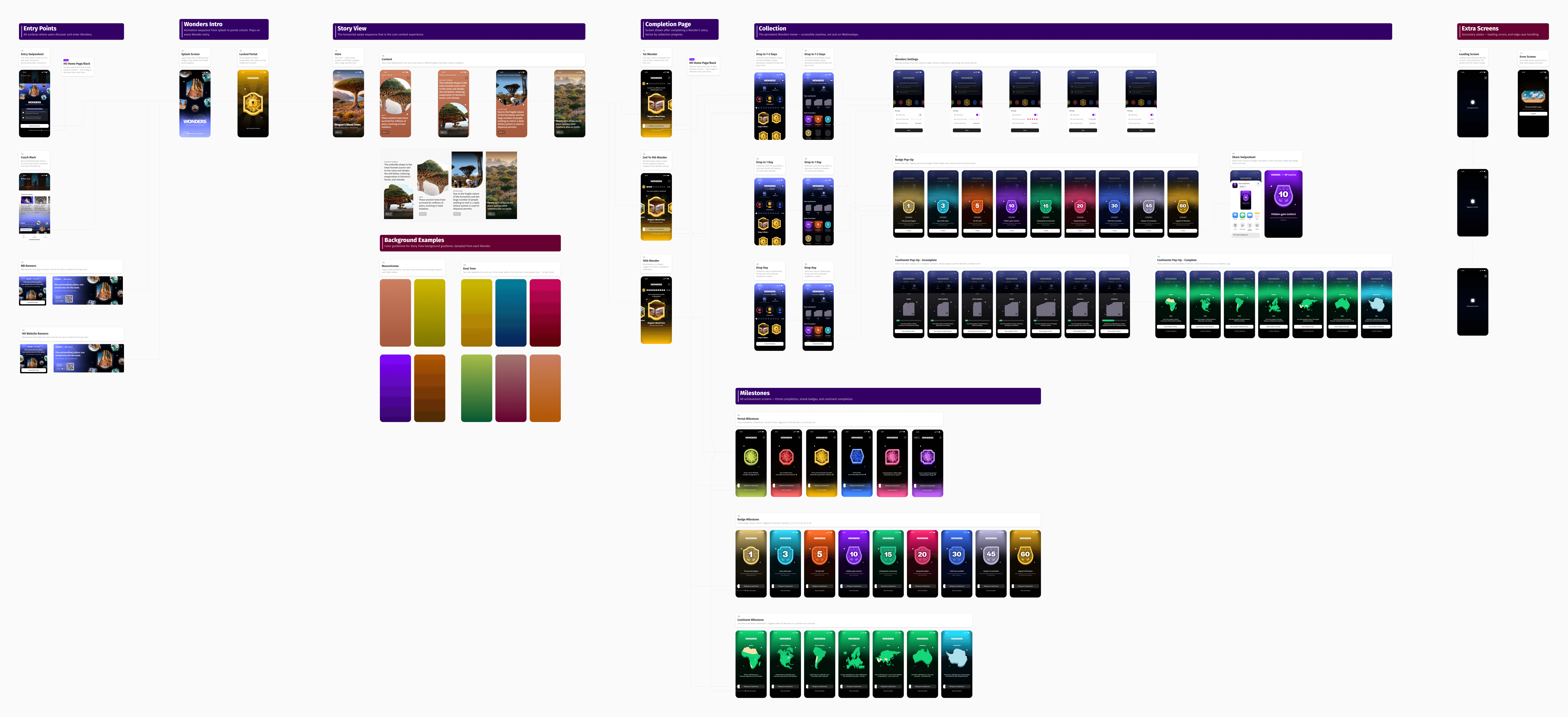
Wonders final hand-off file, complete flow
As of now, the feature is put on a hold, and is set in the pipeline. Headout is currently working on launching Games, post which Wonders will be launched to ensure that there is no immediate clash in new feature launches.
Implementation
Shipping it
Here's the full hand-off file for Wonders. Check the figma link.
Wonders final hand-off file, complete flow
As of now, the feature is put on a hold, and is set in the pipeline. Headout is currently working on launching Games, post which Wonders will be launched to ensure that there is no immediate clash in new feature launches.
Made it this far?
Made it this far?
Talk to me alreadyy
Talk to me alreadyy
Rahul R Nadkarni
" height="28px" id="XJzFPWuNI" width="28px"/><path d="M 16.047 19.653 L 19.248 19.653 C 19.364 19.653 19.476 19.607 19.558 19.525 C 19.64 19.443 19.686 19.332 19.686 19.216 L 19.688 12.452 C 19.688 8.916 18.926 6.199 14.794 6.199 C 13.224 6.141 11.743 6.95 10.944 8.302 C 10.94 8.309 10.934 8.314 10.927 8.317 C 10.919 8.319 10.912 8.32 10.904 8.318 C 10.897 8.316 10.89 8.312 10.886 8.305 C 10.881 8.299 10.879 8.292 10.878 8.284 L 10.878 6.963 C 10.878 6.847 10.832 6.736 10.75 6.653 C 10.668 6.571 10.557 6.525 10.441 6.525 L 7.403 6.525 C 7.287 6.525 7.176 6.571 7.093 6.653 C 7.011 6.736 6.965 6.847 6.965 6.963 L 6.965 19.215 C 6.965 19.331 7.011 19.442 7.093 19.524 C 7.176 19.606 7.287 19.652 7.403 19.652 L 10.604 19.652 C 10.72 19.652 10.831 19.606 10.913 19.524 C 10.995 19.442 11.042 19.331 11.042 19.215 L 11.042 13.159 C 11.042 11.446 11.366 9.788 13.489 9.788 C 15.582 9.788 15.609 11.747 15.609 13.269 L 15.609 19.216 C 15.609 19.332 15.656 19.443 15.738 19.525 C 15.82 19.607 15.931 19.653 16.047 19.653 Z M 0 2.366 C 0 3.663 1.068 4.731 2.366 4.731 C 3.663 4.731 4.731 3.662 4.731 2.365 C 4.731 1.068 3.663 0 2.366 0 C 1.068 0 0 1.068 0 2.366 Z M 0.761 19.653 L 3.967 19.653 C 4.083 19.653 4.194 19.607 4.276 19.525 C 4.358 19.443 4.404 19.332 4.404 19.216 L 4.404 6.963 C 4.404 6.847 4.358 6.736 4.276 6.653 C 4.194 6.571 4.083 6.525 3.967 6.525 L 0.761 6.525 C 0.645 6.525 0.534 6.571 0.452 6.653 C 0.37 6.736 0.324 6.847 0.324 6.963 L 0.324 19.216 C 0.324 19.332 0.37 19.443 0.452 19.525 C 0.534 19.607 0.645 19.653 0.761 19.653 Z" fill="rgb(255, 255, 255)" height="19.653050093841554px" id="ZUPB2_nkI" transform="translate(4.156 4.156)" width="19.687550151062013px"/></g></svg>)
 scale(1 1) translate(-0.265625, -1.0770178571428572)" id="wFzmyclQj-3363541551-radial-gradient" r="0.991075"><stop offset="0" stop-color="rgb(255, 221, 85)"/><stop offset="1" stop-color="rgb(200, 55, 171)"/></radialGradient></defs><g d="M 0 28 L 0 0 L 28 0 L 28 28 Z M 21.438 0 L 6.563 0 C 2.938 0 0 2.938 0 6.563 L 0 21.438 C 0 25.062 2.938 28 6.563 28 L 21.438 28 C 25.062 28 28 25.062 28 21.438 L 28 6.563 C 28 2.938 25.062 0 21.438 0 Z M 14.001 3.063 C 11.031 3.063 10.658 3.076 9.491 3.129 C 8.327 3.182 7.532 3.366 6.836 3.637 C 6.117 3.916 5.507 4.29 4.899 4.898 C 4.29 5.506 3.917 6.116 3.636 6.835 C 3.365 7.531 3.181 8.326 3.128 9.49 C 3.076 10.657 3.063 11.03 3.063 14 C 3.063 16.971 3.076 17.342 3.129 18.509 C 3.182 19.673 3.366 20.468 3.637 21.163 C 3.916 21.883 4.29 22.493 4.898 23.101 C 5.506 23.709 6.116 24.084 6.835 24.363 C 7.531 24.634 8.326 24.818 9.49 24.872 C 10.657 24.925 11.029 24.938 14 24.938 C 16.97 24.938 17.342 24.925 18.509 24.872 C 19.673 24.818 20.469 24.634 21.165 24.363 C 21.884 24.084 22.493 23.709 23.101 23.101 C 23.709 22.493 24.083 21.883 24.363 21.164 C 24.632 20.468 24.817 19.673 24.871 18.509 C 24.924 17.343 24.938 16.971 24.938 14 C 24.938 11.03 24.924 10.657 24.871 9.49 C 24.817 8.326 24.632 7.531 24.363 6.836 C 24.083 6.116 23.709 5.506 23.101 4.898 C 22.492 4.29 21.884 3.916 21.164 3.637 C 20.467 3.366 19.672 3.182 18.507 3.129 C 17.34 3.076 16.969 3.063 13.998 3.063 Z M 13.02 5.034 C 13.311 5.033 13.636 5.034 14.001 5.034 C 16.921 5.034 17.268 5.044 18.421 5.096 C 19.487 5.145 20.066 5.323 20.452 5.473 C 20.962 5.671 21.326 5.908 21.708 6.291 C 22.091 6.674 22.328 7.039 22.527 7.549 C 22.677 7.934 22.855 8.513 22.904 9.579 C 22.956 10.732 22.967 11.079 22.967 13.998 C 22.967 16.917 22.956 17.263 22.904 18.416 C 22.855 19.482 22.677 20.061 22.527 20.446 C 22.329 20.957 22.091 21.32 21.708 21.703 C 21.326 22.085 20.962 22.322 20.452 22.521 C 20.066 22.671 19.487 22.849 18.421 22.898 C 17.268 22.95 16.921 22.961 14.001 22.961 C 11.081 22.961 10.734 22.95 9.581 22.898 C 8.515 22.848 7.936 22.67 7.55 22.52 C 7.04 22.322 6.675 22.085 6.292 21.702 C 5.91 21.32 5.673 20.956 5.474 20.445 C 5.324 20.06 5.146 19.481 5.097 18.415 C 5.045 17.262 5.034 16.916 5.034 13.995 C 5.034 11.074 5.045 10.73 5.097 9.577 C 5.146 8.51 5.324 7.931 5.474 7.546 C 5.672 7.035 5.91 6.671 6.293 6.288 C 6.675 5.905 7.04 5.668 7.55 5.47 C 7.936 5.319 8.515 5.141 9.581 5.092 C 10.59 5.047 10.981 5.033 13.02 5.031 Z M 19.839 6.85 C 19.115 6.85 18.527 7.437 18.527 8.162 C 18.527 8.886 19.115 9.474 19.839 9.474 C 20.564 9.474 21.152 8.886 21.152 8.162 C 21.152 7.437 20.564 6.849 19.839 6.849 Z M 14.001 8.383 C 10.899 8.383 8.384 10.898 8.384 14 C 8.384 17.102 10.899 19.616 14.001 19.616 C 17.103 19.616 19.617 17.102 19.617 14 C 19.617 10.898 17.103 8.383 14.001 8.383 Z M 14.001 10.354 C 16.014 10.354 17.647 11.986 17.647 14 C 17.647 16.014 16.014 17.646 14.001 17.646 C 11.987 17.646 10.355 16.014 10.355 14 C 10.355 11.986 11.987 10.354 14.001 10.354 Z" fill="transparent" height="28px" id="EjRzqQIH2" width="28px"><path d="M 0 28 L 0 0 L 28 0 L 28 28 Z" fill="transparent" height="28px" id="BZljef8e7" width="28px"/><path d="M 21.438 0 L 6.563 0 C 2.938 0 0 2.938 0 6.563 L 0 21.438 C 0 25.062 2.938 28 6.563 28 L 21.438 28 C 25.062 28 28 25.062 28 21.438 L 28 6.563 C 28 2.938 25.062 0 21.438 0 Z" fill="url(%23wFzmyclQj-3363541551-radial-gradient)" height="28px" id="wFzmyclQj" width="28px"/><path d="M 10.938 0 C 7.968 0 7.595 0.013 6.429 0.066 C 5.264 0.119 4.469 0.304 3.774 0.574 C 3.055 0.854 2.444 1.227 1.836 1.835 C 1.228 2.443 0.854 3.054 0.574 3.773 C 0.303 4.468 0.118 5.264 0.066 6.427 C 0.014 7.594 0 7.967 0 10.938 C 0 13.908 0.013 14.28 0.066 15.446 C 0.12 16.611 0.304 17.406 0.574 18.101 C 0.854 18.82 1.228 19.431 1.836 20.039 C 2.443 20.647 3.054 21.022 3.773 21.301 C 4.469 21.572 5.263 21.756 6.428 21.809 C 7.594 21.862 7.967 21.875 10.937 21.875 C 13.908 21.875 14.28 21.862 15.446 21.809 C 16.611 21.756 17.406 21.572 18.102 21.301 C 18.821 21.022 19.431 20.647 20.038 20.039 C 20.647 19.431 21.02 18.82 21.301 18.101 C 21.57 17.406 21.754 16.611 21.809 15.447 C 21.861 14.28 21.875 13.908 21.875 10.938 C 21.875 7.967 21.861 7.594 21.809 6.428 C 21.754 5.263 21.57 4.469 21.301 3.773 C 21.02 3.054 20.647 2.443 20.038 1.835 C 19.43 1.227 18.822 0.853 18.102 0.574 C 17.404 0.304 16.609 0.119 15.445 0.066 C 14.278 0.013 13.907 0 10.935 0 Z M 9.957 1.971 C 10.249 1.971 10.574 1.971 10.939 1.971 C 13.859 1.971 14.205 1.982 15.358 2.034 C 16.425 2.083 17.003 2.261 17.389 2.411 C 17.899 2.609 18.263 2.846 18.646 3.229 C 19.029 3.612 19.266 3.976 19.464 4.487 C 19.614 4.872 19.793 5.45 19.841 6.517 C 19.894 7.67 19.905 8.016 19.905 10.935 C 19.905 13.854 19.894 14.2 19.841 15.353 C 19.792 16.42 19.614 16.999 19.464 17.384 C 19.266 17.894 19.029 18.258 18.646 18.64 C 18.263 19.023 17.9 19.26 17.389 19.458 C 17.004 19.609 16.425 19.786 15.358 19.835 C 14.205 19.887 13.859 19.899 10.939 19.899 C 8.018 19.899 7.672 19.887 6.519 19.835 C 5.452 19.786 4.874 19.608 4.488 19.458 C 3.977 19.26 3.613 19.023 3.23 18.64 C 2.847 18.257 2.61 17.893 2.412 17.383 C 2.262 16.998 2.083 16.419 2.035 15.352 C 1.982 14.199 1.972 13.853 1.972 10.932 C 1.972 8.011 1.982 7.667 2.035 6.514 C 2.084 5.448 2.262 4.869 2.412 4.483 C 2.61 3.973 2.847 3.608 3.23 3.225 C 3.613 2.843 3.977 2.606 4.488 2.407 C 4.873 2.257 5.452 2.079 6.519 2.03 C 7.528 1.984 7.919 1.971 9.957 1.968 Z M 16.777 3.787 C 16.052 3.787 15.464 4.374 15.464 5.099 C 15.464 5.824 16.052 6.412 16.777 6.412 C 17.502 6.412 18.089 5.824 18.089 5.099 C 18.089 4.375 17.502 3.787 16.777 3.787 Z M 10.939 5.321 C 7.837 5.321 5.322 7.836 5.322 10.938 C 5.322 14.04 7.837 16.553 10.939 16.553 C 14.041 16.553 16.555 14.04 16.555 10.938 C 16.555 7.836 14.04 5.321 10.938 5.321 Z M 10.938 7.292 C 12.952 7.292 14.584 8.924 14.584 10.938 C 14.584 12.951 12.952 14.583 10.938 14.583 C 8.925 14.583 7.293 12.951 7.293 10.938 C 7.293 8.924 8.925 7.292 10.938 7.292 Z" fill="rgb(255, 255, 255)" height="21.8752px" id="KE8cjtzrG" transform="translate(3.063 3.063)" width="21.875px"/></g></svg>)
" height="25.30639px" id="byVWVtYKR" transform="translate(0.002 1.347)" width="27.99774688px"/></svg>)
" height="26.107812000000003px" id="dh7uIoWdW" transform="translate(0.94 0.93)" width="26.11877px"/><path d="M 14 27.967 C 6.278 27.967 0 21.7 0 13.989 C 0 6.267 6.278 0 14 0 C 21.722 0 28 6.267 28 13.978 C 28 21.689 21.722 27.967 14 27.967 Z M 25.802 15.892 C 25.397 15.761 22.105 14.788 18.353 15.378 C 19.917 19.666 20.552 23.166 20.672 23.888 C 23.362 22.083 25.277 19.217 25.802 15.892 Z M 18.67 24.992 C 18.495 23.942 17.795 20.289 16.122 15.936 C 16.1 15.947 16.067 15.958 16.045 15.958 C 9.297 18.309 6.88 22.98 6.661 23.417 C 8.684 24.992 11.233 25.933 14 25.933 C 15.652 25.944 17.238 25.605 18.67 24.992 Z M 5.119 21.984 C 5.392 21.525 8.673 16.1 14.842 14.098 C 14.995 14.044 15.159 14 15.312 13.956 C 15.017 13.278 14.689 12.6 14.339 11.933 C 8.367 13.716 2.57 13.639 2.045 13.628 C 2.045 13.748 2.034 13.869 2.034 13.989 C 2.045 17.063 3.205 19.863 5.119 21.984 Z M 2.297 11.55 C 2.833 11.561 7.755 11.583 13.355 10.095 C 11.375 6.573 9.231 3.62 8.925 3.194 C 5.567 4.769 3.073 7.853 2.297 11.55 Z M 11.2 2.384 C 11.528 2.822 13.705 5.775 15.662 9.373 C 19.917 7.777 21.711 5.37 21.93 5.064 C 19.819 3.194 17.041 2.056 14 2.056 C 13.037 2.056 12.097 2.177 11.2 2.384 Z M 23.253 6.442 C 23.002 6.781 21 9.352 16.581 11.156 C 16.855 11.725 17.128 12.305 17.38 12.884 C 17.467 13.092 17.555 13.3 17.642 13.497 C 21.623 12.994 25.572 13.803 25.966 13.88 C 25.933 11.069 24.927 8.477 23.253 6.442 Z" fill="rgb(178, 33, 90)" height="27.9672px" id="KpgWUffmE" width="28px"/></g></svg>)
© Rahul R Nadkarni • 2026 (footer size increasing activity)